
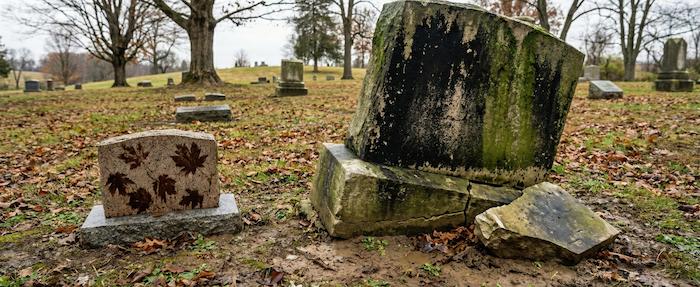
Confluence Clay Pushes Columbus Headstones Out of Plumb
Dig a few feet down almost anywhere in Columbus and you hit heavy gray clay, the glacial till left behind when the Wisconsinan ice sheet retreated from the Scioto and Olentangy river valleys. That clay swells with spring rain and pulls tight again in a dry August. A granite marker set on a shallow footing rides that movement year after year, and the base tilts a few degrees at a time until the whole stone leans. Older sections in Franklin County cemeteries show this constantly: markers that once stood square now lean toward the aisle, corners sunk lower than the rest of the base. Many of these markers date back more than a century, and their footings were never poured to today's depth standards. Tending's crew re-levels these stones on compacted gravel pads set below the clay's active zone, then repoints the base seam. Water stops working underneath it after that. For anyone searching headstone cleaning services near me in Columbus, this leaning-and-sinking problem is usually the issue that needs solving first. Left alone, a leaning stone eventually topples, and a fallen marker cracks against its own base or a neighboring one. The headstone repair and restoration process resets the footing, corrects the pitch, and rebuilds the base with a flexible mortar that moves with the clay. The seam stays sealed through the next freeze-thaw cycle.

Interstate Soot and Humid Summers Layer Grime at Green Lawn
I-70 and I-71 cross through downtown Columbus at the interchange locals call Spaghetti Junction, and decades of diesel exhaust have drifted into cemeteries near that corridor. The soot lands as a fine black film that settles into the stone's pore structure and darkens it unevenly, heaviest on the side facing traffic. Limestone and marble surfaces take on that soot faster than dense granite does. Green Lawn Cemetery, a National Historic Landmark with dense old tree cover over its historic sections, adds a second layer on top of that: shaded, humid Columbus summers grow algae and moss on marble and limestone that rarely dries out completely. Tending's technicians apply a D/2 biological solution formulated for cemetery stone. A soft tampico brush lifts the loosened growth away afterward. Soot gets a separate pass with a chelating detergent that breaks the bond between carbon particulate and stone. The polish underneath stays intact. Bronze plaques and statuary in these same shaded, damp sections corrode on a different timeline than stone: a green patina forms, and metal wall thickness thins over years of trapped moisture. That calls for dedicated bronze grave marker restoration, a separate process from the cleaning used on granite or marble.
"Somehow I trusted that Tending would do a great job on my great great grandmother's very old and darkened headstone. They are the real deal. The work was done beautifully and it was so touching to see the headstone clean and readable again. Do not hesitate to hire Tending. They will bring your loved one's resting place shine again. "
— Louise Rosen Byer, Columbus, Ohio
Freeze-Thaw Seams Crack Lettering Across Franklin County
Ohio winters run through repeated freeze-thaw cycles. Water gets into a hairline seam around carved lettering, expands as ice, and forces the crack wider each time it refreezes. Marble and limestone markers lose definition first: letters and dates thin at the edges until a name gets hard to read from a few feet away. Crews fill these seams with a lime-based mortar compatible with older stone before winter sets in. Soft or crumbling letterforms get stabilized with a breathable consolidant that hardens the surface and still lets moisture pass through it. On stones where lettering has already eroded past legibility, gravestone lettering repair recuts or re-fills the letterforms. The inscription reads clearly again afterward. Mortar bonds cleanly to a narrow seam. A seam left through another winter only gets wider and costs more to close. Granite markers resist this cracking longer than marble does, but old repair joints on granite bases still open up after enough winters.
Service Costs in Columbus
Tending prices every job through our online calculator, where the monument type and a chosen care plan set a fixed cost before work starts. No on-site visit is required to get that number. Monument restoration services and ongoing grave site cleaning services both run through the same calculator. A caretaker managing several plots at Union Cemetery sees the same upfront pricing every time.

- Clay-heave leveling and base resetting: $180-$450 depending on monument size and depth of the sunk footing
- Soot, algae, and biological growth removal: $95-$220 per stone, more for double markers with heavy shade exposure
- Freeze-thaw crack and lettering repair: $120-$380 depending on seam length and letterform condition