
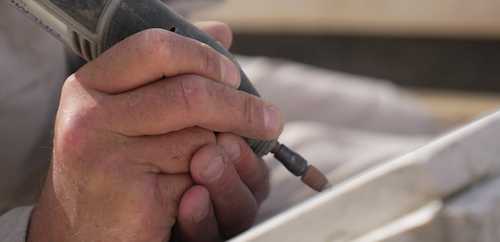
The reason painted lettering fails changes depending on where the headstone sits in Ohio. Near Lake Erie, freezing rain shears paint straight out of the carved groove. Along the state's interstate corridors, blowing grit works its way into the letters year-round. Across the old Black Swamp lowlands, grooves stay damp long enough for mold to take hold underneath the paint. And on plenty of older lettering statewide, decades of industrial emissions have degraded the binder into a chalky film that ordinary weathering wouldn't explain on its own. Our guide to restoring faded headstone lettering walks through what each of those actually looks like. Tending's lettering work across Ohio is backed by a $2,000,000 liability policy and the ICCFA's membership standards.
Lake Erie Freezing Rain and Sheared Paint
Freezing rain near the lakeshore fills a carved letter groove with liquid water before the temperature drops hard enough to lock it solid. The ice that forms expands with enough mechanical force to shear the paint layer clean off the granite underneath it, and the flakes that break loose usually blow away before anyone notices the letters are gone.
Tending's crew picks out whatever paint is still clinging to the groove, lets the stone dry fully, and lays down a new coat once the bare carving is ready for it.
Interstate Corridor Grit
Headstones near Ohio's dense interstate network pick up a steady dusting of crushed roadway grit that wind carries off passing traffic, and that grit packs tightly into a carved letter groove the same way it settles into a windowsill. Once it's compacted, plain rinsing rarely clears it, and paint applied over the top just seals the grit in without ever bonding to the actual stone.
The crew works the packed grit free with a pick before any solvent goes near the groove, since paint sealed over trapped debris fails within a season or two. Stones set close to the shoulder of a road tend to need this cleared out again sooner than ones set further back in the same cemetery, simply because there's more passing traffic kicking material loose.
Black Swamp Drainage and Groove Mold
The old Black Swamp lowlands of northwest Ohio never really drained well even after the wetlands themselves were cleared, and cemetery ground there can stay soaked well past the point where the rest of the state has dried out. A letter groove sitting in that kind of moisture for that long grows a black mold underneath the enamel long before ordinary weathering would ever fade the paint on its own.
Before any enamel goes back on, the crew applies a biocide treatment to knock the colony down completely, because painting over live mold just locks it in under a surface that looks clean.
Statewide Industrial Residue and Binder Breakdown
Decades of regional industrial emissions have left a fine sulfurous film on older stonework across much of Ohio, and that residue mixes into rainwater and dew in a way that slowly breaks down a paint binder from the surface inward. Lettering affected this way tends to chalk and soften well before it visibly fades, which is different from the sharp flaking caused by freeze damage.
The crew strips the softened paint down to bare granite completely, since a partial repaint over compromised binder leaves a patchy, uneven finish once the surrounding letters weather further. Older stones in cemeteries near a former industrial corridor usually show this pattern across every letter on the face, not in a single isolated spot, which is one way the crew tells binder breakdown apart from ordinary sun fading.
Headstone Lettering Repair Costs in Ohio
Character count and carving depth are what determine a lettering repair quote, and the pricing tool pulls both measurements straight from uploaded photos. Whether the job is near the interstate corridors or along the lakeshore doesn't change the number, since the lettering itself is what the price is based on. Finished photos get added to the app once the repaint is done, letting the family review the work without a trip back out to the cemetery.
- Freeze-shear repair: clearing the sheared groove and repainting the affected letters.
- Grit removal: mechanical clearing of packed roadway debris before repainting.
- Mold treatment: biocide treatment and repaint of affected grooves.
- Binder breakdown repaint: full paint removal and repaint down to bare granite.
How Our Headstone Lettering Repair Process Works
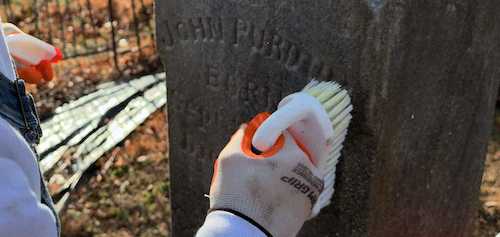
- Clearing Ice-Sheared Paint Out of the Groove Whatever's left in the groove, sheared paint, packed grit, or mold-softened enamel, gets cleared mechanically down to bare stone before anything else happens.
- Flushing Out What's Left Clinging to the Walls A solvent flush lifts whatever film is still stuck to the inner walls of the groove, leaving bare stone for the new enamel to grip.
- Making Sure Nothing Stays Wet Underneath Painting over a damp groove is one of the fastest ways a repaint fails, so the crew waits until every trace of moisture is gone before moving on.
- Matching New Enamel to the Carved Depth A weather-resistant, commercial-grade enamel fills the dry groove to the exact depth and font of the original carving.
- Finishing the Face and Uploading the Proof Any stray paint on the surrounding granite gets cleaned off, and the finished letters get photographed for the app so the family has a record.
