
Great Miami River Sand and Gravel Settles Headstone Bases
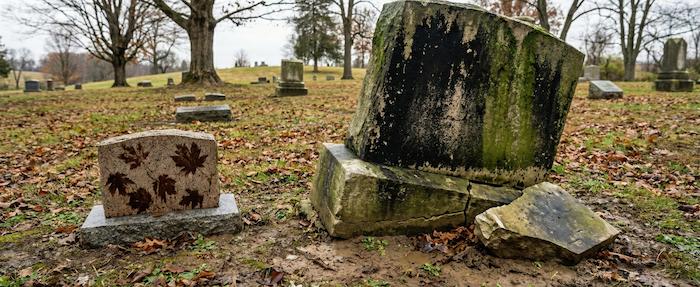
Fairfield's ground is built from that outwash, left behind where the Great Miami River carved through the valley — a mix of sand and gravel deep enough that the region calls it a buried valley aquifer. That loose, well-draining ground behaves nothing like the clay soil common further inland. Sand and gravel wash and settle under a headstone a little at a time, especially after heavy spring rain moves through the loose fill faster than through packed clay, and they don't swell and push a base sideways the way clay does. A base with no proper footing can end up resting on a hollowed-out pocket where solid ground used to be.
"A year ago I traveled to Ohio and visited the cemetery where most of my family is buried. I was appalled at the condition of the gravestones for my loved ones. Because of this, I came back home and decided to look for someone who could clean and maintain those gravestones. I saw an ad in FaceBook of Tending and was thrilled to contact them. I am soooo glad I did. They were easy to work with; they did exactly what they said they would do; they charged exactly what they said they would; and, I have been so very impressed with their business and their work ethic. I am very pleased with this company and recommend them to anyone who could use their service."
— Beck, Ohio

Once that settling starts, a stone tips toward whichever side lost the most material underneath it, and the movement rarely stops on its own. A slight lean this year often becomes a noticeable one within a couple more wet springs. Headstone cleaning services near me searches from Fairfield often begin once a family notices a stone has dropped or leans more than it used to. Tending resets affected bases on compacted gravel packed to resist further washout, checking that the fill underneath is solid before setting the stone level again. Larger structural repairs are covered under headstone repair and restoration.
Spring Flooding Along the Great Miami Leaves Silt on Low Ground
Low-lying sections of Fairfield flood periodically when the Great Miami River overflows its banks, usually sometime between midwinter and midspring, and the backwater can push into Pleasant Run Creek as well, extending the affected area well past the riverbank itself. Cemetery plots on lower ground take the brunt of it, and floodwater leaves behind a layer of fine river silt once it recedes. That silt dries into a stubborn gray-brown film that regular rain never fully washes away on its own, since it works into the same pores that ordinary grime does but in a thicker, more compacted layer.
Bronze veterans' plaques in the same low areas pick up the same silt coating, and it dulls the metal's finish the same way it dulls stone. Tending clears flood silt with a soft-wash approach suited to the buildup, not a standard grime cleaning, and cleans and restores bronze grave markers caught in the same flood zone on the same visit.
Interbedded Limestone and Shale Wear Unevenly on Older Markers
Older monuments quarried from local stone often came from the same Cincinnatian-age rock that underlies the county, layers of limestone alternating with softer shale laid down when this whole region sat under a shallow sea. The shale wears away faster than the limestone bands next to it, so a marker cut from this material develops a stepped, grooved texture as the softer layers recede and the harder ones stay proud of the surface. Engraved lettering cut across those layers wears unevenly for the same reason, fading fastest wherever a shale band happens to run through a letter.

Granite and modern quarried marble don't show this pattern, since they're uniform stone without alternating layers to begin with, but older local-stone markers in Fairfield's cemeteries need a different kind of attention. Tending stabilizes the softer bands before they erode further and recuts affected lettering, following headstone lettering repair standards adapted for layered stone.
Service Costs in Fairfield
Every job is priced through Tending's online calculator once the monument type and care plan are selected, with no in-person visit needed to assess the damage first. A maintenance plan can be added for plots in flood-prone, low-lying sections that need more frequent checks.
- Base resetting and stabilization: correcting settling caused by washed-out sand and gravel fill.
- Flood silt and bronze cleaning: soft-wash removal of river silt from stone and metal markers.
- Layered-stone stabilization and lettering repair: repairing uneven wear on older quarried monuments.