The Meaning Behind Headstone Symbols: Crosses, Doves, Anchors and More
Cemetery headstones often carry carved symbols with specific meanings — crosses and doves signal Christian faith, the Star of David and Hebrew inscriptions mark Jewish graves, anchors represent hope, broken columns indicate a life cut short, and clasped hands or a ring signify marriage. Carving style can also help date a stone: winged skulls dominate the early 1700s, cherub faces appear from the 1690s onward, and the willow-and-urn motif becomes common by the early 1800s.
Walk through almost any older cemetery and you'll notice the stones are rarely just names and dates. A lamb rests on one marker, an anchor on another, a column snapped in half on a third. These carvings aren't decoration — or not only decoration. For centuries, families chose symbols deliberately, encoding a person's faith, work, character, or the circumstances of their death into the stone. For anyone researching family history, these symbols are a kind of visual language, and they often reveal what written records leave out.
This guide walks through the most common headstone symbols and what they mean, so the next time you stand in front of a family grave, you can read more of what it's saying.
Why symbols matter for family history
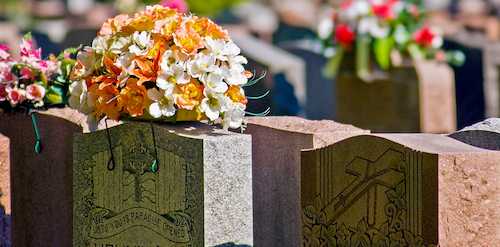
Before the meanings themselves, it's worth understanding why they're useful. A carved symbol can tell you things a census never recorded. A Masonic square and compass identifies a lodge membership that may appear in no other document; a military emblem can confirm service when courthouse records were destroyed; and a weeping willow can place a stone in the early 19th century even after the inscription has worn away. For genealogists, symbols add context, dates, and personality to an ancestor who might otherwise be just a name.
It helps to remember that many symbols have more than one meaning, and the right reading depends on era, region, and the other carvings around it. What follows are the most widely accepted interpretations, not rigid rules.

Religious symbols
Religious imagery is the most common category by far. The cross, in its many forms, marks Christian faith and resurrection. The ornate Celtic cross — a cross with a ring around the intersection — is common on graves of Scottish, Irish, or Welsh descent.
Two lettered monograms appear constantly and confuse many visitors: IHS, from the first three letters of "Jesus" in Greek, and INRI, the Latin "Iesus Nazarenus Rex Iudaeorum" — the inscription placed over Christ during the Crucifixion. The Alpha and Omega, the first and last letters of the Greek alphabet, represent God as the beginning and the end.
Other common symbols include the dove, a sign of peace and the soul drawn from the story of Noah; the lily, an image of purity and resurrection; and the lamb, representing innocence and Christ, most often found on children's graves.

Jewish headstone symbols
Jewish tradition uses its own set of carved symbols and inscriptions, distinct from the Christian imagery above. Many stones open with the Hebrew letters פ"נ (an abbreviation for "here lies") and close with the letters תנצב"ה, a blessing that the soul be bound up in the bond of life. A pair of hands, palms out and fingers split into a V-shape, marks the grave of a Kohen, a descendant of the priestly line, echoing the traditional priestly blessing offered in the ancient Temple. A pitcher or ewer, often pouring water over open hands, marks a Levite — a reference to the Levites' role of washing the Kohanim's hands before that same blessing, a symbol especially common on Ashkenazi headstones. The Star of David appears widely as a general symbol of Jewish identity and faith, without the more specific lineage meaning carried by the hands or the pitcher.

Symbols of hope and the afterlife
A second group speaks to hope, resurrection, and eternal life. The anchor is one of the most layered. It symbolizes hope and steadfastness, is often found on sailors' headstones, was used by Masons as a sign of well-grounded hope, and was used by early Christians as a disguised cross during times of persecution. An anchor with a severed chain, however, usually marks a death — often a premature one.
The butterfly is a gentler symbol of the same idea: transformation and resurrection, drawn from its metamorphosis, and often found on children's graves representing hope rather than sorrow. Birds taking flight represent the soul's flight to God, and ivy, with its evergreen leaves, stands for immortality and lasting attachment.
Symbols of mourning and a life's end
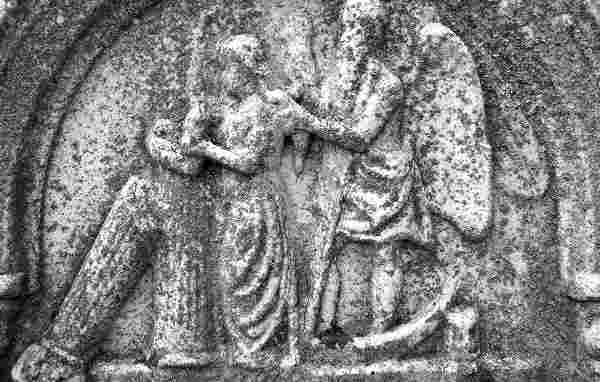
Late 18th and early 19th centuries, stands for mourning and grief, and in some traditions for immortality as well. The draped urn — an urn covered with cloth — is among the most common of all, the urn representing death and the drape representing mourning and the veil between life and death.
A broken element of any kind tells a particular story. A broken column, sword, branch, or tree stump typically indicates a life cut short. A broken chain signifies the death of a family member and a family broken by loss. The hourglass and the scythe, by contrast, are reminders of time passing and the inevitability of death — themes more common on older stones.

Dating a stone by its carving style (colonial New England)
For anyone tracing colonial-era ancestors, the style of carving can offer a rough clue to a stone's age even when weathering has erased the inscription. Early New England gravestones, common through the early-to-mid 1700s, often featured a death's head — a winged skull, blunt and unsentimental, reflecting the Puritan focus on mortality. Starting around the 1690s, a second motif appeared alongside it: the winged cherub, or soul effigy — a stylized face associated with the soul's ascent to heaven. By the late 1700s and into the early 1800s, the willow and urn motif described above became the dominant style, reflecting a shift toward neoclassical taste and a more sentimental, less overtly religious approach to mourning.
Researchers who've studied this progression are careful to note it wasn't a clean handoff — the cherub never fully displaced the death's head, and the two appear side by side on stones from the same period. Treat the general order (death's head, then cherub, then willow and urn) as a loose clue rather than a precise dating tool, especially useful when other records are missing.
Symbols of love and family
Among the most touching are the symbols of human bonds. Clasped hands, one of the most common carvings, can mean a final farewell or God welcoming the deceased into heaven — and when one hand is clearly a woman's, shown by the sleeve, it represents a marriage. A ring represents matrimony; a double arch can represent a couple reunited in death.
Symbols of work, character, and membership
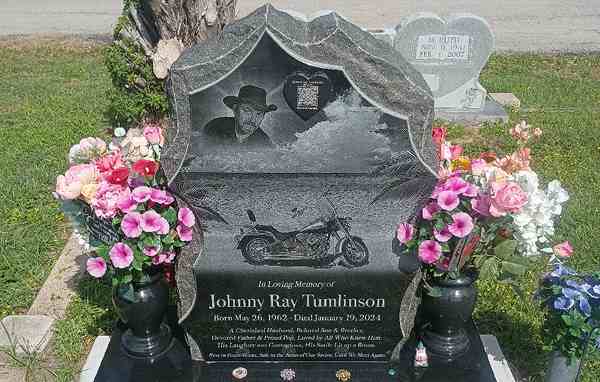
Finally, a large group of symbols records who a person was in life. A pile of books topped with an apple marks a teacher; a quill and ink an author; a hammer and anvil a blacksmith; an ear of corn a farmer. Character was carved too: a lion for bravery, an oak or acorn for strength and endurance, a dog for loyalty.
Membership in organizations was a common source of imagery. An interlocked compass and square marks a Freemason; three links of a chain, often with the letters F, L, T inside, mark the Independent Order of Odd Fellows, standing for Friendship, Love and Truth — a symbol easy to confuse with three interlocking rings representing the Holy Trinity.
What a coin left on a grave means
Sometimes what's on a headstone wasn't carved at all — it was left there by a visitor. The custom of leaving a coin with the dead is an old one, tracing back to ancient Greek and Roman practice tied to the myth of paying a ferryman for passage into the afterlife. The specific American code — where the denomination itself carries a meaning — is much more recent, and is often traced to the Vietnam War, when leaving a coin let a veteran acknowledge a fallen comrade without necessarily engaging the family directly, in an era when discussing the war openly could be difficult.
The code itself is fairly consistent wherever it's described: a penny means someone visited; a nickel means the visitor trained with the person at boot camp; a dime means they served together in some capacity; and a quarter — the most significant — means the visitor was present when that person died.
It's a small detail, and an easy one to miss if you can't visit often — coins are typically collected periodically by the cemetery or veterans' groups and put toward cemetery upkeep, so a photo taken during a routine visit is often the only record that someone else stopped by.
Reading a stone for yourself
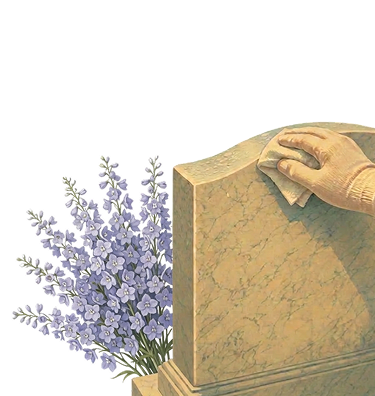
There's no need to memorize all of this. The point is simply to look more closely — to notice that the symbols are there and that they were chosen for a reason. When you visit a family grave, take in the carvings alongside the name and dates, and photograph them; they're part of the record. And because these symbols are carved details, they're often the first thing lost as a stone weathers — fine lines fill with grime, shallow reliefs erode, and a meaningful emblem slowly becomes unreadable. Keeping a monument clean isn't only about appearance; it's about preserving the very details that carry the story — which is the kind of detail-safe restoration Tending specializes in.


The takeaway
A headstone is a message written for people the deceased would never meet. The symbols carved into it were a way of saying something lasting — about faith, love, work, or hope — to the generations who would one day stand where you're standing. Learning to read that language turns a quiet walk through a cemetery into a conversation with the past.