Headstone Symbols and What They Mean: Trinity Rings, Tree Stones, and Heaven's Gate
Three overlapping rings usually mean the Holy Trinity; three linked rings with F-L-T mean the Odd Fellows fraternity; two rings mean a marriage. A headstone carved to look like a tree stump, especially with an axe or the motto "Dum Tacet Clamat," marks a member of the Woodmen of the World. Clouds, a reaching hand, and an arch or gate together describe the soul's passage into heaven.
In our first guide to headstone symbols, we covered crosses, doves, anchors, and the imagery most families run into first. But cemeteries hold a much larger visual vocabulary than that, and a few symbols in particular get misread often enough that they're worth their own closer look: rings that aren't what they first appear to be, monuments carved to look like trees, and the quiet language cemeteries use for heaven itself.
As before, treat these as the most widely accepted readings, not fixed rules. Symbolism on stone is regional, it changes over time, and the safest interpretation usually comes from reading a symbol alongside whatever else is carved next to it.
Three Rings or Three Links? Telling the Trinity, the Odd Fellows, and a Marriage Apart
Connected circles show up on headstones for several genuinely different reasons, and the count and arrangement matter as much as the shape itself.
Three interlocking circles, drawn so they overlap like a knot, are a Christian symbol for the Holy Trinity: Father, Son, and Holy Spirit as three persons in one. It's an old visual shorthand for a doctrine that's notoriously hard to draw any other way.
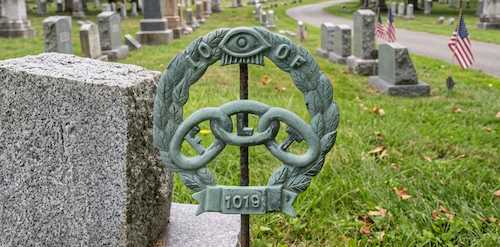
Three linked rings in a chain are something else entirely: the emblem of the Independent Order of Odd Fellows, a fraternal and mutual-aid society, sometimes carved with the letters F, L, T worked into or beside the links, standing for Friendship, Love, and Truth. Some sources describe this same Odd Fellows emblem as “three linked rings” rather than a chain, which is exactly why the two get confused. The clearest tell isn't the word used to describe it, it's what's carved alongside it: F, L, T or the initials I.O.O.F. point to the fraternity; a cross, a Bible, or other explicitly religious carving nearby points to the Trinity.
A third reading belongs to a different count entirely. Two interlocking rings, rather than three, are read as wedding rings: marriage, unity, and a bond meant to last beyond death, sometimes carved alongside two names or a wedding date that confirms the reading. Since all three of these symbols rely on circles that overlap or link, the number carved, two or three, along with whatever names, letters, or other imagery sits nearby, is what actually tells you which one you're looking at.

When a Headstone Is Shaped Like a Tree
Most carved trees on a headstone are just decoration with meaning attached, the way a weeping willow signals mourning. But every so often, a whole monument is carved to look like a tree, bark, knots, and all, and that's a different story with a specific origin.
From around 1890 through the early 1900s, the fraternal insurance society Woodmen of the World (and the related Modern Woodmen of America) included a tombstone as part of a member's benefit. The organization's standard design was a tree stump, often finished with an axe, a mallet, or a wedge carved into the stone, and its motto, Dum Tacet Clamat, “Though silent, he speaks,” worked somewhere into the design. A child's grave in the same family plot sometimes used a stack of three carved logs instead of a full stump. A trunk carved leaning rather than upright generally signals mourning specifically, and where a Woodmen stump is shown with ivy growing up it, sources don't fully agree on the reading: some read the ivy as marking a life cut short too soon, others as a separate note of immortality alongside the stump's own meaning. These monuments are concentrated in the South and Midwest, and finding one is a reliable sign the person buried there belonged to the order, whether or not any other record survives.
Separate from the Woodmen tradition, a tree carved simply as an image, rather than a stone shaped like one, tends to carry its own meaning depending on its condition and type. A full, living tree generally stands for life; a tree of life specifically points to immortality, since a tree keeps producing the seeds of its own renewal even as it ages. A broken trunk or a stump (the same broken-life imagery covered in our first guide) marks a life cut short. An oak or its acorn carries more than one association: strength and endurance most often, but also authority, power, and victory, which is part of why oak leaves and acorns turn up so often on military graves. A palm branch carries a meaning aimed squarely at a cemetery's purpose: in Christian tradition it stands for victory specifically over death and resurrection, tied to Easter and Palm Sunday, a older and more pointed reading than the general Roman association with triumph and rejoicing that the same branch also carries.

Clouds, a Reaching Hand, and the Gates of Heaven
Some of the plainest symbols on a headstone are also the easiest to walk past without noticing. Clouds carved across the top of a stone are a simple, direct symbol: the divine abode, heaven itself, sometimes shown with rays breaking through them to suggest glory or the presence of God. This is one of the few symbols in this guide where sources largely agree on a single reading.
Clouds also frame one of the more striking Victorian motifs: a single hand emerging from them. A finger pointing upward is read consistently as the soul's ascent and the hope of heaven. A finger pointing downward is read less consistently, and it's worth knowing all of the accepted versions rather than just one: some sources read it as God's hand reaching down to gather the soul peacefully, others as a more solemn call to judgment, and others simply as the hand indicating the grave itself, the earth as a final resting place. The hand is sometimes shown gripping a chain with a broken link, standing for the family the deceased has been separated from, regardless of which reading of the finger's direction applies.
An arch or a gate carved into a monument completes the same visual language, and it too carries more than one accepted meaning. Both are read as marking the soul's passage, departure from earthly life on one hand, and a triumphant entrance into heaven on the other, with the gate specifically doubling as the passage the soul takes on its way through. Together, clouds, the reaching hand, and an arch or gate form a small, coherent set, describing where the person carved beneath them was believed to be going as much as mourning that they were gone.
Why Symbols Started Appearing on Headstones at All
When gravestones were first commonly carved in the American colonies, many of the people ordering them, and often the stonemasons carving them, couldn't read or write. A name and a date told only part of a story, so carvers reached for images instead: a symbol was something anyone in the community could understand at a glance, regardless of literacy. The earliest widespread motif, the winged skull, grew out of the Puritan practice of memento mori, Latin for “remember you must die,” a blunt reminder of mortality rather than a mark of piracy or ill will, whatever the skull and crossbones might suggest today.
Over the following century, that stark imagery softened. Skulls gave way to winged cherub faces representing the soul's ascent, and by the early 1800s, urns and weeping willows had largely replaced both, reflecting a more sentimental, less overtly religious approach to mourning that carried into the Victorian era's fuller cast of symbols: doves, clasped hands, clouds, and the rest of the visual language covered in this guide and the last.

How These Symbols Are Actually Carved
The method behind a carved symbol has changed more in the last century than in the two hundred years before it, and it's part of why older and newer stones weather so differently.
For most of gravestone history, carving meant a hammer, a chisel, and hours of patient, one-strike-at-a-time work; the oldest technique, a deep V-shaped cut, is still made this way on the highest-end relief work today. Marble and limestone, being relatively soft, were the easiest stones to hand-carve, which is part of why so much fine 18th- and 19th-century detail survives on them, and also why that same detail erodes faster than anything cut into granite.
Modern granite monuments are carved differently. Because granite is so much harder, most lettering and symbols are sandblasted: a rubber stencil is cut to the design, applied to the polished stone, and high-pressure sand carves away everything the stencil doesn't cover. Sandblasting can produce three levels of detail: flat lettering, shaped outlines, or true sculptural relief deep enough to cast its own shadow, which is the most expensive and time-consuming to produce. Laser etching, mostly used on black granite for portraits, works more like fine engraving than carving, and because it doesn't cut nearly as deep as sandblasting, it tends to fade faster outdoors over the decades. Bronze plaques and appliques aren't carved at all; the design is cast into the metal in a mold before the piece is ever mounted on a stone.
This matters beyond trivia: sandblasting is a legitimate and common way to carve a brand-new symbol, but it's exactly the kind of abrasive force that permanently destroys a symbol if it's ever used to clean an existing, weathered one. The same technique that's right for cutting stone is wrong for preserving it.
Cleaning Carved Symbols Without Erasing Them
A carved or relief symbol is harder to clean safely than a flat inscription, for a simple reason: dirt, algae, and biological growth collect in the recesses and undercuts of a carving far more than they do on an open, flat surface, and those same recesses are usually the most fragile part of the whole design.
The core rules are the same ones that apply to any headstone: plain water or a pH-neutral cleaner, soft natural-bristle brushes, no bleach, no vinegar, no pressure washing. But carved detail adds a layer of care on top. Grime lodged deep in a groove should come out with a wooden or plastic tool, like a craft stick or a plastic scraper, worked gently, never a metal pick or knife, which can chip or widen the very line that defines the symbol. A grout brush or toothbrush-sized brush helps reach tight crevices around lettering and relief without the heavier pressure a full-sized brush needs for open stone. And on softer materials, the edges of a carved symbol, the crispest, most detailed part, are also the first place damage shows.
This is also where knowing the difference matters most. A professional can usually tell whether a symbol looks faint because it's dirty, which can be safely cleaned, or because the carving itself has already worn away, in which case there's nothing left to clean and further scrubbing only causes damage for no benefit. That judgment call, more than any single product or tool, is the real reason a heavily carved or historic stone is worth having a conservator look at before anyone reaches for a brush.
Frequently asked questions
Why did people start carving symbols on gravestones instead of just names and dates?
Largely because of literacy. When many people, including the stonemasons themselves, couldn't read or write, a carved image communicated something a name alone couldn't, faith, cause of death, or a life's work, at a glance, regardless of who was looking at it.
What tools are used to carve headstone symbols today?
Most modern granite symbols are sandblasted through a rubber stencil, which can produce flat, shaped, or fully sculptural relief detail. Black granite portraits are often laser-etched instead, and the finest hand-carved relief work is still cut with a hammer and chisel, much as it was centuries ago. Bronze symbols are cast in a mold rather than carved at all.
Is it safe to clean the carved symbols on a headstone myself?
Light dirt can be removed with plain water and a soft brush, working gently into any grooves with a wooden or plastic tool rather than metal. But carved detail is usually the most fragile part of a stone, and it's often hard to tell whether a faint symbol is dirty or already worn away, which is exactly the judgment a professional is best positioned to make before you start.
Why does a heavily carved or symbol-covered headstone need more careful cleaning than a plain one?
Dirt, algae, and biological growth build up in carved recesses far more than on a flat, open surface, and those same recesses are usually the most fragile, detailed part of the design. Cleaning a plain surface and cleaning intricate relief carving without wearing it down are two very different jobs.