
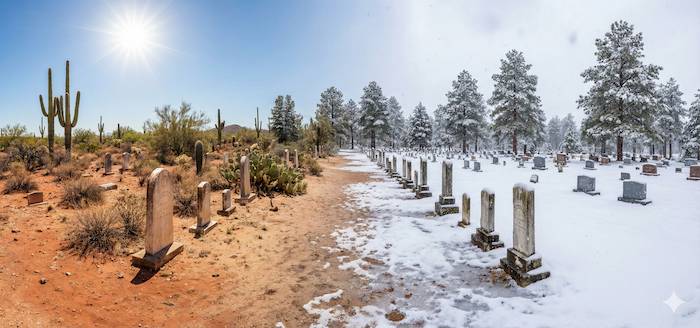
Southern Pacific Rail Yard Soot Blackens Grave Markers
Ore from the Tombstone and Bisbee mines used to come through Benson for smelting, and the rail yard here has run since 1880. Trains still roll through today. Coal smoke from those early decades worked its way into the soil around town. Diesel exhaust from today's freight lines adds to it. People searching for headstone cleaning services near me close to the tracks usually describe a dark gray film that regular rinsing never fully clears. Markers set within a few blocks of the old depot show it heaviest, especially on the side facing the rail yard.
We use a chelating degreaser built for rail soot and diesel residue. We work it in by hand, never with a sprayer. Bronze veterans' plaques near the old depot pick up the same film and dull faster than granite does. Those get bronze grave marker cleaning at the same visit, so one trip covers both materials. Markers set closer to the yard sometimes need a second light pass within a year or two, though most clear up fully the first time through.
Mineral-Rich Groundwater Crusts Grave Markers
The same mineral-rich water that carved Kartchner Caverns into the limestone south of town runs through the ground under Benson too. It reaches the surface here instead, evaporates off a headstone, and leaves behind a hard white mineral crust. Flat markers set low to the ground catch more of it than upright stones do, since water pools there longer after every rain.
Scraping that crust off just scratches the polish underneath. We use a buffered acid wash built to dissolve mineral deposits. The stone's finish stays intact underneath. Grave cleaners near me searches from families near the older part of town usually mention the same chalky white buildup building back within a year of a plain rinse.
San Pedro Valley Winds Scour Grave Markers
Wind channels down the San Pedro Valley between the Whetstone and Dragoon Mountains and picks up speed with nothing to slow it down. That wind carries fine grit that wears down exposed granite year after year. The polish goes dull and flat under it, losing the depth of color it once had. Engraved letters lose their sharp edges first, since the grit settles into the grooves and grinds them soft. Markers on the open, western side of a cemetery usually show this worse than sheltered ones.
We restore the surface with a stone enhancer built to fill in wind-scoured micro-scratches. For letters that have worn down at the edges, not just lost their shine, we also offer gravestone lettering repair to bring the depth back. Markers facing the open valley usually need this more than ones sheltered by trees or a wall.
Monsoon Runoff Undermines Grave Footings
Runoff from the Whetstone and Dragoon foothills funnels down toward the San Pedro River during monsoon season, and the loose, sandy soil around Benson doesn't hold up well against fast-moving water. A footer that seemed solid in June can lose its support entirely after one hard summer storm, and the monument above it tips as a result. Plots on lower ground near the wash channels take the worst of this.
We backfill washed-out ground with compacted material and reset the stone level once the base sits solid again on ground that won't move the same way twice. For monuments that have shifted badly, we handle full tombstone repair and restoration to rebuild the footing from the ground up, starting well below the surface. Most repairs hold through several monsoon seasons without further movement, even during a heavier storm than usual.
"This was truly an incredible experience. Dachi, and the team of people did a fantastic job. We worked with Dachi and he went above and beyond what was expected. We are very appreciative of the work. Blessing to the crew! We recommend their work."
— Oscar Miranda, Tucson, Arizona

Service Costs in Benson
You pick your monument type and plan in our online calculator. That price is fixed once you book. No site visit needed to get the quote.