
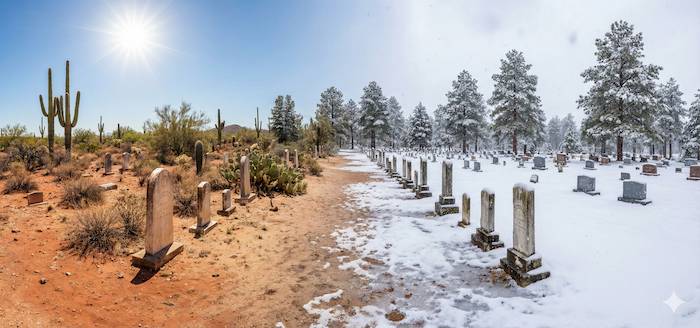
A headstone outside Yuma bakes past 115 degrees most summer afternoons and cools fast enough after dark to stress-crack from the swing; a marker up in Flagstaff spends winter nights locked in ice instead. Headstone cleaning looks the same on Tending's schedule across all 867 of Arizona's cemeteries: a $2,000,000 liability policy and ICCFA membership travel with the crew to every one of them. The right fix always depends on which kind of damage caused it.
What Arizona's Desert Heat and Elevation Do to a Headstone
Summers push well past 100 degrees across Arizona's low desert, and elevation flips the outcome by the time the land climbs to the Mogollon Rim, where winter nights regularly drop below freezing. Arizona's old copper-mining towns add a hazard of their own: decades of smelter exhaust settled into the local air.
Sonoran Desert Heat and Headstone Lettering Repair
Yuma, Phoenix, and Tucson cemeteries sit under some of the most intense UV exposure in the country, and painted inscriptions absorb most of it every single day. Ultraviolet radiation breaks down pigment molecules directly, fading a black-painted letter to gray within a handful of summer seasons. Daily heat adds to the damage on its own: surface temperatures climb high enough by afternoon that any moisture left on the stone flashes off almost instantly, leaving the paint to bake and crack in place. Marble found in some of Arizona's older cemetery sections bleaches out fastest on whichever face catches the most direct afternoon sun, since its coarser crystal grain offers little resistance to sustained UV exposure. Well water and sprinkler lines across the low desert carry a heavy calcium load, and the mineral residue leaves a chalky white film behind every time it evaporates off a sun-baked marker. The film blurs a painted letter's edges once it settles in, even in spots where the paint underneath hasn't actually failed. A mild acid rinse dissolves the mineral film without touching sound paint, and headstone lettering repair goes in afterward to repaint whatever the UV exposure has already taken.
High Country Freeze-Thaw and Headstone Repair
Flagstaff and Prescott sit high enough that winter nights regularly drop below freezing, no matter how warm the afternoon got. Meltwater from the daily thaw soaks into granite's natural pore structure and expands by roughly nine percent the moment it refreezes after sunset, and the stone has nowhere to send the extra volume. Pressure pushes outward against the pore walls from the inside with every freeze-thaw cycle. Even a hairline surface flaw left over from the original quarrying gives meltwater enough of an opening to start that pressure building. A single winter rarely does enough damage to notice; the same cycle repeated over ten or twenty years turns a small surface flaw into a crack running the length of the stone. Cemeteries on north-facing slopes above 6,000 feet hold onto snow well into spring, giving meltwater extra weeks each year to find its way into a hairline crack. Soil underneath the monument swells as it freezes too, shifting the base out of level, and markers that started out perfectly plumb end up tilted within a season or two. Headstone repair resets the tilted base and seals whatever cracks the freeze-thaw cycle has already opened, ahead of the next winter's round of expansion.
Copper Belt Sulfur and Bronze Marker Restoration
Miami and Hayden, in Arizona's old copper belt, have run smelting operations for more than a century, and the EPA still tracks both towns as sulfur dioxide nonattainment areas as a result. Sulfur dioxide reacts directly with bare bronze, forming a dense, dark sulfate crust once the gas works past whatever clear coat originally protected the plaque. Many of the plaques closest to the smelter stacks mark multiple generations of the same mining families, so the corrosion on them has often had eighty or a hundred years to build up. SO2 concentration in the air stays highest close to either smelter corridor, and a bronze marker inside that zone can pick up heavy sulfate tarnish within just a few years, since the gas never really lets up. Standard bronze cleaners lift surface dirt. They do nothing against sulfate already bonded into the metal's surface layer, so the crust returns within a season once a home product wears off. A chelating treatment for sulfate corrosion strips the sulfate bond down at the molecular level, and a wax seal goes on afterward to hold up against whatever the smelter-town air sends next. Every bronze marker restoration job in the copper belt follows the same order: strip first, seal second.