
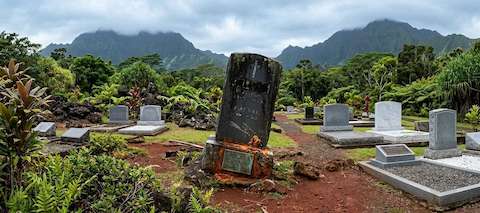
A monument set on an old lava-rock base in an upland Big Island cemetery can work loose within a decade as the porous rock traps rainwater against the setting joint; a bronze veteran's marker on an oceanfront Oahu plot corrodes green from salt spray, nowhere near any lava rock. No matter which of Hawaii's 341 cemeteries a headstone cleaning visit happens at, Tending backs it with the same $2,000,000 liability policy and ICCFA membership. What actually saves a Hawaii headstone depends on exactly which threat is doing the damage.
How Hawaii's Volcanic Ground and Tropical Climate Wear Down a Headstone
Hawaii's volcanic ground undermines a heavy monument more than one way — sometimes through a porous lava-rock setting joint, sometimes through a foundation that loses its footing after a tropical downpour. Ocean salt attacks bronze along the coast, and tropical sun bleaches painted letters everywhere else on the islands.
Big Island Lava Rock and Headstone Repair
Many of Hawaii's older monuments, especially on the Big Island, sit on a base cut from local lava rock. Volcanic rock was the material available on hand for most of the islands' history, long before granite had to be shipped in from the mainland. Lava rock is naturally porous, and it holds rainwater against the setting joint between the base and the die for weeks after a storm has already passed. The trapped moisture rots the old putty seal in Hawaii's constant heat and humidity, and once the seal fails, the upper stone works loose and starts to wobble with every strong wind. Heavy tropical rain undermines a monument from underneath too: sheet runoff washes the soil out from beneath a concrete foundation fast enough to drop one side of the base within a single storm season. A monument left leaning like that risks snapping its own concrete base under the uneven weight. Headstone repair in Hawaii works the same way whether lava rock or washed-out soil caused the problem — lifting the stone clear with a tripod hoist, clearing out whatever failed material sits underneath, and packing the void with crushed rock that gives water somewhere to drain, so it can't pool against the base again.
Oahu Coastal Salt and Bronze Marker Restoration
Coastal cemeteries on Oahu and the other main islands take a steady dose of ocean salt spray, and the salt works on granite and bronze in two different ways at once. Salt crystallizing inside porous granite can blast a section of polish clean off the face as it dries and expands. Bronze veteran markers face their own damage: chlorides in the salt react straight with the copper in the alloy, turning bare bronze a thick, crusty green within a few salt-heavy seasons. Plaques set flat into the ground at oceanfront cemeteries take the steadiest exposure, since salt-laden groundwater can reach them from below as well as from the air above. The corrosion eventually grows thick enough to make an engraved name or rank illegible, and salt also works into the joint between a bronze plaque and its granite backing, breaking down the putty seal there too. A low-pressure abrasive lifts the green crust off the bronze without gouging the softer metal, and the crew rebuilds a dark patina over the cleaned surface before sealing it with micro-crystalline wax worked deep into the metal to lock salt back out. Bronze marker restoration finishes by clearing the old putty from the joint and resetting it with fresh epoxy, so the seal holds against the next round of salt spray.
Leeward Coast Sun and Headstone Lettering Repair
Hawaii's leeward coastlines, including the Kona side of the Big Island and much of Waikiki, sit in the direct path of intense tropical sun for most of the year, since the trade winds drop their rain and cloud cover on the windward side first. UV radiation this intense breaks down painted lettering fast, since dark pigment in enamel paint absorbs most of the sunlight that hits it. The enamel dries out, cracks, and peels away in flakes within a year or two on an unprotected marker, leaving a blank slab where a name and date used to be readable. Black granite depends on painted lettering for contrast, since carved letters alone barely show up against dark stone. Repainting starts only once the stone is fully dry, since any trapped moisture under fresh enamel pushes the new paint loose within days. Headstone lettering repair clears out whatever paint is left, waits for the groove to dry all the way through, and applies an industrial enamel rated to hold its color under sustained tropical UV. Markers on the leeward side typically need this redone every few years to keep the lettering legible.