
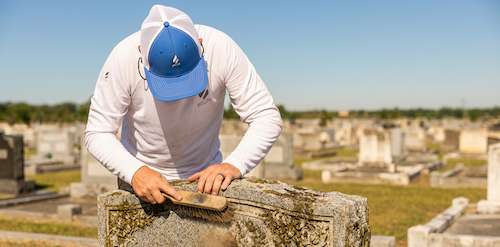
A cemetery footing in Hawaii rarely fails the same way twice, because the ground underneath changes from one side of an island to the other. The Puna and Kona coasts sit on loose volcanic soil that settles unevenly. Windward slopes on the older islands hold onto water in a completely different kind of clay. Tending sends crews to every island for headstone repair, and the full stage-by-stage process is laid out in our restoration methods guide. Every job carries $2,000,000 in liability coverage, and Tending is a member of the ICCFA.
Big Island Volcanic Soil Settling
A footing near Pāhoa or Kona rarely announces trouble with a sudden crack. It leans first. Cemeteries across the Puna and Kona districts sit on cinder and a'a, loose, clinkery volcanic rock that never compacted the way ordinary soil does. Rain works its way between the fragments and carries the finer material out from under a shallow footing. The base settles unevenly as that support disappears. The Big Island also sees more earthquake activity than any other part of the state. Notable events near Kīholo Bay in 2006 and Kalapana in 2018 were strong enough to crack a rigid footing outright. Tending excavates past the loose layer entirely and pours the new footing on ground that hasn't shifted.
Statewide Banyan Root Heave
Tending's crews pull more banyan roots out from under monument bases than any other single cause, statewide. Banyan, an invasive fig planted widely around older Hawaii cemeteries, sends out thick surface roots that spread far beyond the tree's canopy. A root running beneath a stacked monument doesn't swell overnight. It thickens year over year, and that steady growth wedges the joint between the base and the die apart. Sidewalks and building foundations across the islands show the same kind of damage from the same trees. Tending removes the intruding root and rebuilds the joint before resetting the stone.
Windward Saprolite Clay Saturation
Kauai and the windward slopes of Oahu and Maui carry some of the oldest, most deeply weathered soil in the state. Decades of heavy rain have broken the underlying basalt down into saprolite, a soft, clay-rich material that holds water long after a storm passes. A cemetery built into one of these slopes sits on ground that never fully dries out between wet spells. Saturated saprolite loses strength and creeps slowly downhill, carrying a shallow footing with it. Plots on a windward-facing grade see this kind of slow, steady drift far more than flat, drier ground nearby. Tending cuts back the unstable slope material and pins the rebuilt footing into ground that won't creep further.
Oahu Coastal King Tide Erosion
A monument rarely topples from a single king tide event. Low-lying cemeteries near Honolulu and other coastal Oahu communities face recurring king tide flooding. NOAA's Hawaii and Pacific Islands King Tides Project tracks these surges each year. Sea level pushes higher than the normal high-tide line several times during each event. Each surge pulls sand and loose fill out from under a base as the water recedes. Repeated cycles gradually open up the mortar joint holding a stacked monument together. The same undercutting can loosen a bronze plaque bolted to the base, a separate repair covered under bronze marker restoration. Tending backfills the undercut section with compacted fill and reseals the open joint.
Headstone Repair Costs in Hawaii
Uploading photos through the online calculator is how a Hawaii headstone repair gets priced, well before any crew steps onto the cemetery grounds. Damage type and extent drive the figure, and the island doesn't factor into it at all. A footing job near Hilo and a slope repair near Hanalei land on the same price whenever the amount of work lines up. Families check the finished repair afterward through photos the crew posts to the Tending app.
- Volcanic soil settling repair: loose cinder excavated out and the footing set on stable ground.
- Root heave repair: intruding banyan root removed and the joint rebuilt.
- Saprolite slope repair: unstable slope material cut back and the footing pinned in place.
- Coastal erosion repair: undercut section backfilled and the open joint resealed.
How Our Headstone Repair Process Works
- Assessing the Ground and Footing Before touching the monument, a technician traces the movement back to its source: loose volcanic soil, a root system, a saturated slope, or coastal undercutting.
- Rebuilding the Compromised Base Everything unstable comes out first, whether that's loose cinder, a wedged root, or waterlogged clay, down to soil the crew can actually build on.
- Lifting and Leveling the Monument Weight-appropriate rigging raises the stone clear of the old base, giving the crew open access to rebuild the footing correctly underneath it.
- Stabilizing the Stone Where the stone itself has cracked or a joint has opened up, a color-matched compound goes in to restore actual structural strength, not just the surface look.
- Sealing the Base and Logging Photos Once the monument sits level again, the new footing gets a breathable sealant and the crew documents the finished job through the Tending app.
