
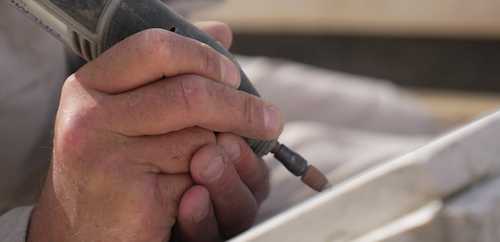
Painted headstone lettering wears down in different ways depending on where it sits in Hawaii. Cemeteries downwind of Kīlauea deal with volcanic ash working into carved letters. The rest of the state deals mainly with sun and moisture instead. Tending walks through the real mechanics of headstone lettering restoration, step by step, in a separate blog post. This service covers headstone lettering repair on every island, backed by $2,000,000 in liability coverage and Tending's ICCFA membership.
Kīlauea Tephra Ash Intrusion
Kīlauea's ongoing eruptive activity continues to send tephra ash drifting across the Puna and Kona districts as of 2026. That fine volcanic ash settles readily into carved letter grooves nearby. Tropical rain wets the ash where it collects. Hawaii's strong sun then bakes the wet material into a hard plug once the rain clears. A plug like that pushes against the paint from underneath until it lifts free of the stone entirely. Cemeteries well outside the Big Island's downwind corridor rarely deal with this kind of buildup. Tending's technicians pick the hardened ash out of the groove by hand until the stone underneath is clean.
Statewide Tropical UV Chalking
Hawaii carries the highest average UV index of any US state, close to double the national average and well ahead of Arizona in second place. That intensity breaks down a paint binder's flexibility far faster than milder mainland sun ever would. Once the binder degrades, solid paint turns into a brittle, powdery chalk that lifts away from the stone in flakes. Grooves facing directly into the afternoon sun show this chalking well before shaded lettering nearby does. Tending's crews strip the chalked residue completely and confirm the groove is clean before repainting.
Windward Humidity and Mold Staining
Windward-facing cemeteries on Kauai, Oahu, and Maui sit in some of the wettest ground in the country. That dampness keeps a carved letter groove wet for days after a storm passes. A groove that stays damp that long grows a dark, sooty mold wherever moisture collects against the old paint. The mold itself does little structural harm, but it darkens the surrounding paint unevenly. It has to come out before a fresh coat will hold. Shaded, windward-facing plots need this cleared considerably more often than open, leeward sections. Tending clears the mold growth and confirms full dryness before repainting.
Formosan Termite Tube Residue
Formosan termites are widely considered Hawaii's most destructive termite species. They build mud shelter tubes to bridge from soil up to any nearby wood source. A fence post, an old wooden grave marker, or a tree stump all qualify. Those tubes sometimes cross directly over a stone or bronze surface on the way. They leave a streak of packed dirt residue behind even though the termites have no interest in the stone itself. That residue sits directly on top of painted lettering and dulls the surface wherever a tube has crossed it. Plots near an old wooden structure or a dead tree stump see this more than open sections without one nearby. Tending clears the tube residue and confirms the groove is sound before repainting.
Headstone Lettering Repair Costs in Hawaii
Two measurements set the price for lettering repair in Hawaii: how many characters are involved, and how deep the original carving runs. A technician works both out from photos submitted through the online calculator, well before anyone books a visit to the cemetery. Island location plays no part in the figure. A groove near Hilo needing a full ash treatment costs the same as a lightly faded one near Lihue. The scope decides the number, not the island. The crew logs the finished repaint with photos in the Tending app.
- Ash intrusion treatment: baked tephra cleared and the groove repainted.
- UV chalking treatment: degraded paint stripped before repainting.
- Mold staining treatment: growth cleared and the groove dried before repainting.
- Termite residue treatment: tube residue cleared before repainting.
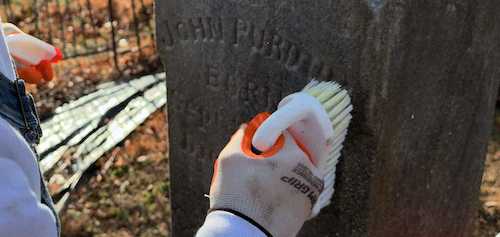
How Our Headstone Lettering Repair Process Works
- Opening Up the Groove By hand, the technician digs out whatever's clogging the letter groove, be it hardened ash, chalked-out old paint, mold, or dirt from a termite tube.
- Washing Out the Residue A solvent wash lifts any film or staining still clinging to the stone walls, since new enamel won't bond to a groove that isn't genuinely clean.
- Letting the Stone Dry Fully Nothing goes back in until the groove reads bone dry; sealing moisture in under fresh paint is one of the most common reasons a repaint fails early.
- Applying Weather-Rated Enamel The dry groove receives an enamel built to survive Hawaii's sun and humidity, packed in to follow the exact depth and shape of the original letters.
- Polishing and Uploading Photos A final pass clears any paint that strayed onto the surrounding stone, and photos of the finished work go up on the Tending app.
