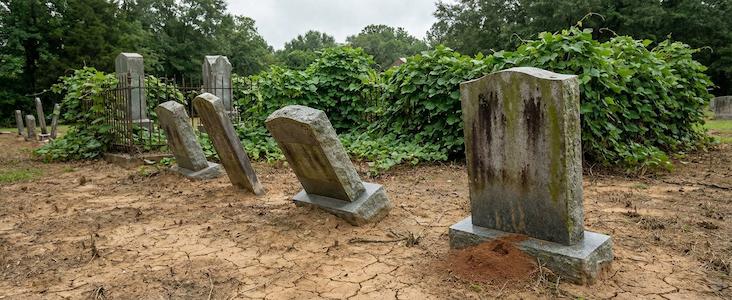
Columbus families searching for headstone cleaning services near me run into one of two things, usually. A marker gone dark despite regular care. Or a base leaning since the ground last moved under it. Columbus was built up along the Tombigbee on red clay hills — typical for northeastern Mississippi — and its antebellum homes survived the Civil War mostly intact. The cemeteries are just as old. Shaped by the same clay, the same river humidity, for just as long, and the two problems rarely trace back to a single cause on any given monument.
Tombigbee Red Clay Tilts Old Bases
Red clay runs all through Lowndes County, starting in the hills northeast and carrying down to the river itself. It swells hard after rain, shrinks back once things dry out completely. That push and pull works unevenly on a footing over time, and older bases — the ones without a real modern foundation — can drift out of level in a handful of years. Sometimes less, depending on how wet the season has actually been that year.
"Dachi and team were kind enough to get our son’s headstone cleaned in time for his birthday. Really great people to work with and highly recommend."
— SK, Tending Client
We dig to the footing, see which side moved, repack with stone that actually drains before resetting the monument level. That drainage layer matters — it keeps future rain from just cycling straight back into the same clay that caused the problem in the first place. If the clay's been at it long enough to crack the stone itself, that's not a routine reset anymore. That's a full headstone restoration.

River Humidity Darkens Shaded Stone
The Tombigbee keeps this air damper than towns further from any real water source, and shaded plots under the old oaks downtown stay wet long after open ground has dried. That's exactly what algae and lichen want. A granite marker in one of those spots can go visibly dark within a single humid season — one summer, sometimes less, especially where the tree cover never really thins out enough to let real sun through. Older sections tend to show it first, simply because the trees there have had longer to grow in.
D/2 lifts the growth without scrubbing, which is the point, since scrubbing wears a polished surface down faster than the algae ever would. Bronze markers common in Columbus's older sections need bronze marker restoration, something else entirely. The granite-strength cleaner dulls bronze fast, sometimes within a single treatment if the wrong product gets used, and there's no undoing that kind of damage once it's done.
Antebellum-Era Marble Wears Unevenly
Columbus holds one of the largest collections of surviving antebellum homes in Mississippi, and its oldest cemeteries are full of marble from that same era. Marble's softer than granite. It reacts to acidic rain differently — carved details wear down, and sometimes the surface goes sugary and granular in a way granite in the same row never does, even after the same number of decades outdoors, side by side in the exact same weather.
Marble needs a gentler, pH-balanced cleaner. Anything stronger just speeds up the same breakdown it's supposed to fix. Where marble lettering has worn past easy reading, we bring it back through gravestone lettering repair — only as deep as the stone itself still allows, working letter by letter where the carving has thinned the most, sometimes taking two or three passes to get right.
Service Costs in Columbus
Every Tending plan in Columbus is priced through our online calculator. Choose the monument type, choose a care plan, see the price — no technician visit needed first, nothing to negotiate over the phone. Book the first cleaning from there, or set up a recurring monument restoration services plan for the year. Clay heave and biological growth run on entirely separate timelines here, so most families start with whichever one's actually visible, and we go from there once that's clear, adjusting the rest of the plan as needed.

- Base releveling and grave marker restoration: footing inspection and drainage repacking for monuments tilted by Tombigbee red clay.
- Biological growth removal: D/2 treatment for river-humidity algae, plus a gentler formula for any bronze markers nearby.
- Marble care and headstone lettering repair: pH-balanced cleaning for antebellum-era marble, with lettering repair for worn inscriptions.