
Mississippi's climate keeps rain falling in most months of the year, and a carved letter groove holds onto that moisture long after the surrounding granite has dried off, which is the biggest single reason a lithochrome paint binder breaks down over time, ahead of ordinary sun exposure. Piney Woods cemeteries add lichen and algae growth that undermines paint adhesion from inside the groove, coastal cemeteries take the brunt of hurricane season's wind-driven grit, and the same Yazoo clay that cracks foundations around Jackson can shift a stone enough to split paint right along the crack line. Tending's lettering crews carry ICCFA membership and $2,000,000 in liability coverage on every job in Mississippi.
Humidity and Paint Binder Breakdown
Rain falls unevenly across a typical Mississippi year, heavy stretches followed by weeks of dry heat, and a carved letter holds onto whatever moisture settles into it well after the surrounding stone has dried. That sustained dampness works at a lithochrome paint's chemical binder over time, turning a once-solid coating brittle enough to crumble away in small chips, not lift off in one clean piece the way a healthier bond would. Once enough of that binder has broken down, a heavy rain is often what finally washes the loosened paint out of the groove entirely, leaving behind a bare, completely unpainted channel.
Biological Growth in the Piney Woods
Conservation research on cemetery monuments documents lichen and algae colonizing the damp, shaded crevices inside carved letters, particularly common under the dense pine canopy of southern Mississippi's Piney Woods region. These organisms produce mild acids, oxalic acid among them, as a byproduct of normal growth, contributing to a documented pattern conservators call biopitting where they attach, and undermining the paint's grip on the stone beneath them in the process. A letter with active growth inside it usually needs that organic material cleared out completely before any new enamel has a real chance of holding.
Hurricane Season Grit on the Coast
Coastal cemeteries from Gulfport to Pascagoula sit through a hurricane season that runs from June through November most years, with the Mississippi coast squarely inside the Gulf's active storm corridor, and even a storm well short of Katrina's scale drives fine sand and windblown grit into exposed letter grooves. That abrasive material works against the paint surface every time wind picks it back up, wearing a dull, pitted texture into enamel that would otherwise fade evenly across the whole letter. A letter facing the prevailing coastal wind typically shows this wear well ahead of one on the sheltered side of the same stone. A monument standing in an open, exposed section of a coastal cemetery generally needs attention within just a few years. One tucked behind a windbreak of trees or a mausoleum wall can go considerably longer before the same wear shows up.
Yazoo Clay Cracks Through Carved Letters
The same Yazoo clay belt that swells and shrinks enough to crack a monument's foundation across Hinds, Madison, and Rankin counties around Jackson can also put enough lateral stress on the stone itself to open a hairline crack straight through a carved inscription. Paint that was sound on either side of that crack loses its grip right at the break, since the stone underneath it is no longer a single stable surface. A repaint over a cracked letter without addressing the underlying foundation movement tends to fail again at the exact same spot within a single season, since the crack itself never actually closed.
Headstone Lettering Repair Costs in Mississippi
Character count and carving depth, both pulled directly from a family's submitted photos, are the only two inputs the calculator needs to set a fixed price, and no cemetery visit changes that number no matter which of the four causes was actually responsible. Once the repaint is finished, the crew documents it with clear photos uploaded through the Tending app for the family to see.
How Our Headstone Lettering Repair Process Works
- Reading the Wear Pattern in the Photos Binder breakdown, organic growth inside the groove, wind-scoured grit, and a crack running through the letter each show up looking different, giving a technician a starting theory before the visit.
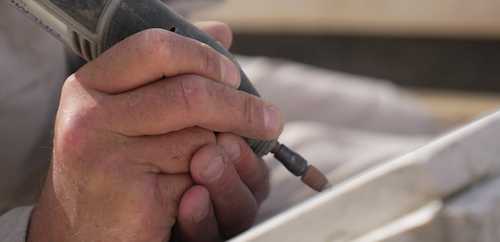
- Picking the Dead Paint Out by Hand A pick works failed enamel and any organic material out of the carved channel one letter at a time, leaving anything still bonded to the stone untouched.
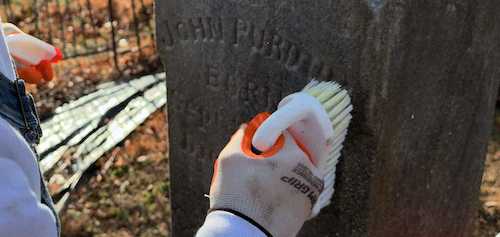
- Rinsing the Channel Down to Solid Stone Whatever rinse matches what's actually in the groove, biological film, embedded grit, or ordinary dust, clears it out until only material firm enough to hold new paint is left.
- Running Compressed Air Through the Groove Every trace of dampness gets driven out before any enamel goes in, since sealing paint over even slightly damp stone is one of the fastest ways a Mississippi repaint fails early.
- Filling the Letters and Closing Out the Job Humidity-resistant enamel builds up inside the dry channel in thin coats until it matches the letter's original depth, and the crew uploads finished photos through Tending's app.
