
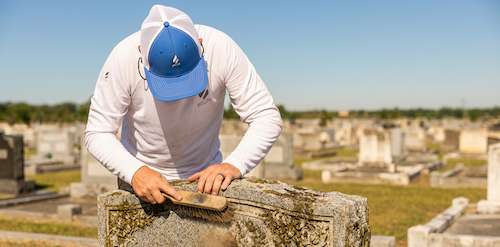
Central Mississippi sits on top of Yazoo clay, a marine formation running through eleven counties from Yazoo and Hinds to Clarke and Wayne, that swells when it rains and shrinks hard in a dry spell, cracking whatever concrete foundation sits above it. Coastal cemeteries from Gulfport to Pascagoula carry a different risk entirely, storm surge from hurricane season; the Delta floods for months at a stretch, and rural Piney Woods cemeteries deal with pine roots working under old bases. Tending repairs headstones anywhere in Mississippi, backed by $2,000,000 in liability coverage and ICCFA membership.
The Yazoo Clay Belt Around Jackson
Yazoo clay runs in a belt six to thirty miles wide across eleven central Mississippi counties, Yazoo, Holmes, Hinds, Madison, Rankin, Smith, Scott, Newton, Jasper, Clarke, and Wayne, and state geological surveys describe it absorbing water like a sponge before swelling with enough force to lift concrete. A dry summer reverses the process just as hard, and the clay shrinks back down and pulls away from whatever base sits on it. A monument foundation poured directly onto this clay rides that swelling and shrinking every year until the concrete finally cracks and the stone above it tips. Tending rebuilds these foundations with a footing designed to isolate the base from that seasonal clay movement, so the stone above no longer rides the clay's swelling and shrinking directly.
Storm Surge Along the Gulf Coast
Hurricane season runs from June through November along the Mississippi coast, and the damage a major storm does to a cemetery has nothing to do with wind alone. Hurricane Katrina's storm surge in 2005 tore open mausoleums and displaced dozens of caskets at Biloxi's Southern Memorial Park, and at Live Oaks Cemetery in Pass Christian, disinterred remains kept turning up for months, some of them found buried in beach sand. A monument base doesn't need a direct hit to shift; floodwater alone carries enough force to knock a heavy granite die off its footing and drop it at an angle once the water recedes. Resetting and re-anchoring these storm-shifted monuments across the Gulf Coast counties has to wait until the water is gone and the ground underneath is stable enough to hold a rebuilt footing.
Delta Backwater Flooding
The Yazoo Backwater Area of the Mississippi Delta stayed underwater for months during the 2019 flood, the longest flood duration on record for that part of the state, and cemeteries throughout the Delta sat partly submerged the entire time. Standing water that long softens the ground under a monument base far past what a normal rainy season would do, and when the water finally drops, the base is often left tilted in soil that settled unevenly underneath it. Tending re-levels Delta monuments after flooding once the ground has dried enough to hold a rebuilt footing.
Pine Roots in the Piney Woods
Southern Mississippi's Piney Woods region carries dense stands of loblolly and longleaf pine, and older rural cemeteries out among them were often planted before anyone thought about how far a mature pine's root system would eventually reach. A root growing under a monument's footing doesn't need to touch the stone directly to cause damage; it only has to lift and shift the soil underneath as it thickens year over year, tilting the base above it. Neglected plots in this region also see kudzu vines, which the Mississippi Forestry Commission has documented growing a foot a day, wrap around leaning stones and pull them further off plumb under sheer vine weight. Clearing that vine growth and the root-damaged soil beneath it comes before any base can be reset properly.
Headstone Repair Costs in Mississippi
Whichever of these four causes moved the stone, pricing follows the same process. A family submits photos, the calculator returns a fixed number, and no crew has to walk the cemetery first to confirm it. That number holds from the initial quote through the day the repair happens. Once the new footing is in and the monument is reset, the crew uploads photos of the finished work through the Tending app for the family to review.
How Our Headstone Repair Process Works
- Sorting Photos Into a Mississippi Pattern Submitted photos get weighed against the four regional causes common to the state, clay heave, storm surge, backwater flooding, or root and vine pressure, before a crew heads out.
- Digging Down to See What Actually Failed The crew opens up the ground around the base to check the real depth of the clay movement, the storm damage, or the root system before deciding on a fix.
- Freeing the Monument From the Broken Foundation Heavy rigging lifts the stone away from whatever's underneath it. Pieces that separate during the lift get tagged so each one returns to its exact original spot.
- Pouring a Foundation Built for the Cause The new footing gets built specifically against what failed, isolated from clay movement, compacted after flood exposure, or cleared of root and vine growth.
- Setting the Monument Back and Documenting It The stone comes back down level with the ground, and photos of the completed work get uploaded through Tending's app before the crew leaves the site.
