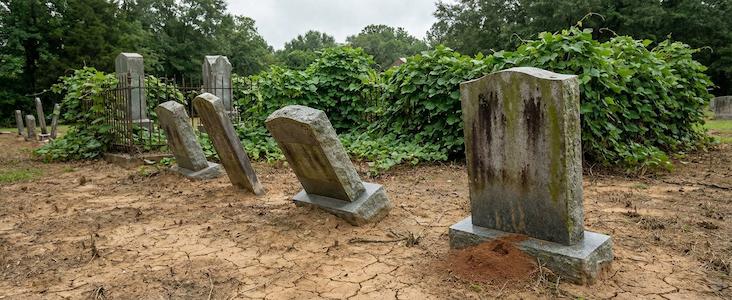
A monument in a Jackson-area cemetery can separate from its own footing as Yazoo clay swells and shrinks underneath it, sometimes moving several inches in a single season; a granite marker two hundred miles north in the Delta collects packed river silt in its lettering instead, with no clay movement involved. Tending treats a headstone cleaning visit the same way in Jackson, in the Delta, or anywhere else among Mississippi's 9,481 cemeteries — always with a $2,000,000 liability policy and ICCFA membership attached. Which fix actually helps a Mississippi headstone depends on what's really behind the damage.
How Mississippi's Clay Soil and Delta Climate Shape Headstone Care
Central Mississippi's Yazoo clay moves a monument's foundation on its own, and invasive kudzu vines root directly into cracks in the same stone, prying it apart from a different angle. River silt packed into engraved letters is a problem of its own along the Delta, and fire ants building acidic mounds against a base reach bronze and granite alike statewide.
Central Mississippi Yazoo Clay and Headstone Repair
Central Mississippi sits on Yazoo clay, one of the most notoriously expansive soils in the country, capable of swelling by as much as 200 percent when wet and exerting close to 25,000 pounds of pressure per square foot against anything sitting on top of it. The pressure pushes a monument's base upward during wet seasons, and the clay shrinks away from the footing just as dramatically once the ground dries out again, leaving gaps where solid support used to be. A monument can separate visibly from an unreinforced concrete footer within just a handful of these wet-dry cycles, tilting or sinking as the clay underneath keeps moving each season. Kudzu vines add their own pressure to an already-stressed monument, since a vine seeking out any hairline crack in the base will root directly into it and keep thickening year after year. A root thick enough can split the stone outright or pop a mortar joint loose on its own. Pulling a mature vine off the stone by hand only tears loose whatever surface it's already gripping. Headstone repair on Yazoo clay means excavating the unstable soil and replacing it with a deep gravel bed that absorbs ground movement before it ever reaches the footing. Where kudzu has taken root, the crew cuts the main stems at ground level first and treats the remaining root system chemically, letting the plant release its grip on its own.
Mississippi Delta River Silt and Headstone Lettering Repair
The Mississippi Delta floods regularly when the river and its tributaries rise, and floodwater retreating off a cemetery leaves behind a heavy layer of fine river silt on everything it touched. The silt packs directly into engraved letters, since a carved groove is exactly the kind of low spot floodwater and settling sediment collect in first. Once the water fully recedes and the silt dries, it sets almost as hard as mortar, filling a letter and erasing whatever name or date used to be legible there. Scraping the dried silt out with a metal tool digs into the surrounding granite just as easily as it digs into the silt itself, leaving permanent scratches behind. Re-wetting the hardened silt gradually turns it back into a soft, flowable mud, and a low-pressure rinse clears it out of each letter without ever touching the stone with anything abrasive. Headstone lettering repair finishes by confirming every letter is fully legible again once the silt is gone, repainting any that need it.
Mississippi Fire Ants and Bronze Marker Restoration
Fire ants use the thermal mass of a granite base or bronze plaque as a heat source, building mounds directly against the stone or metal to take advantage of the warmth it holds overnight. Fire ant mounds carry a naturally acidic soil chemistry, and mound material left sitting against a surface for months at a time slowly etches whatever it's touching. On granite, the acid leaves a dull, permanently etched ring right at the base where a mound sat longest. On bronze, the same acidic soil reacts with the metal's surface, breaking down the protective patina and leaving a rough, discolored band right where the mound built up against the plaque. A mound left undisturbed for a full season etches material away permanently, since the acid works its way below the surface over time. Clearing the ants and treating the surrounding soil stops any further etching, and bronze marker restoration polishes out whatever discoloration the acid left behind before resealing the plaque against future mounds.