
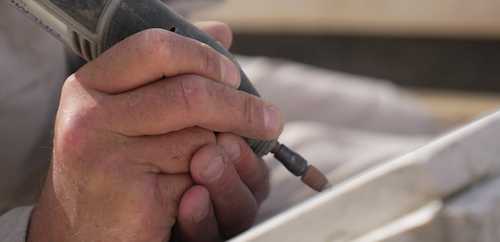
Elevation does most of the work in deciding how fast painted lettering fails on a Montana headstone. A letter carved into stone near Big Sky or Bozeman takes a harder dose of sun each summer than one down on the plains near Sidney, a chinook thaw along the Rocky Mountain Front can crack a groove's paint film in the middle of January, and open wind on the eastern plains sandblasts a letter's surface on an ordinary windy afternoon. Every crew Tending sends out anywhere in the state works from the same $2,000,000 liability policy and ICCFA membership, and every job runs through the same fixed-price process regardless of which of those three problems brought the family to the calculator in the first place.
High-Altitude UV in the Mountain Valleys
UV intensity climbs roughly 6 percent for every kilometer of elevation, and a carved letter near Big Sky or Bozeman sits thousands of feet higher than one down on the plains near Sidney or Miles City. That extra UV load breaks the chemical bonds in a standard paint binder faster, and the pigment turns brittle and starts flaking out of the groove years ahead of a letter at lower elevation. A letter on the south-facing side of a monument in one of these mountain valleys typically shows this brittleness earliest, since that face collects the most direct sun through the long summer days. Repainting over that kind of cracked, sun-baked film without stripping it first only buries the same failure under a coat that won't hold either, so every carved letter gets picked clean down to bare granite before new enamel goes in.
Chinook Cycling Along the Rocky Mountain Front
Warm downslope chinook winds are a regular winter fixture around Great Falls, Choteau, and the rest of the Rocky Mountain Front, and a single afternoon can undo a week of hard freeze before nightfall brings the cold right back. Moisture that works into a carved groove during one of those warm afternoons freezes solid again by the following morning, and that repeated flexing between wet and frozen is what actually cracks a paint film, not the cold sitting there on its own. A monument with a footing that's also failing from this same back-and-forth sometimes gets flagged for both jobs on the same visit; when that happens, the structural side is handled under headstone repair as a separate job.
Wind-Driven Grit on the Eastern Plains
Out on Montana's open high plains, around Miles City, Glendive, and Sidney, sustained wind carries fine grit and dust across a cemetery for most of the year, an area USDA soil conservation programs flag specifically for wind erosion. That abrasive material wears against a painted letter's surface every time the wind picks it back up, dulling and pitting the enamel in a way that looks different from simple sun-fading. A letter on the side of a monument that faces the prevailing wind typically wears first, sometimes years before the sheltered side needs any attention. Tending's crews treat that wind-worn texture as its own repaint case, not the same fix as a UV-bleached letter from the mountains.
Moisture and Growth in the Flathead Valley
Northwest Montana's Flathead Valley stays damp most years, and that persistent moisture lets mildew and algae take hold directly inside a carved letter's grooves where a simple rinse rarely reaches. By the time a family notices the discoloration from a few feet away, the growth has usually already worked underneath the film and broken its grip on the stone. A monument set under a stand of pine or larch trees, common around the lake country near Kalispell and Whitefish, stays shaded and damp for most of the day, which is exactly the condition that growth needs to establish itself. Tending's crews handle the mildew and the repaint in one combined visit.
Headstone Lettering Repair Costs in Montana
What sets the price here is how many characters need repainting and how deep those grooves run, worked out straight from a family's own photos through the calculator; no crew needs to walk the cemetery first to write a number down. A weathered veteran's marker out past Wolf Point and a large family monument in a Bozeman cemetery get quoted the same way, character by character, with elevation and region left out of the math entirely. The crew photographs the finished lettering and uploads it through the app before packing up, so a family can sign off without driving out to see it themselves.
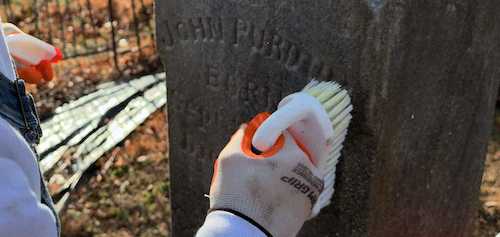
How Our Headstone Lettering Repair Process Works
- Picking the Old Paint Free Old, brittle, or wind-worn paint gets mechanically picked out of each carved letter down to bare granite before anything new goes in.
- Flushing the Channel Out Whatever grit, algae, or leftover paint film remains gets flushed out with a solvent wash, leaving a clean channel for the new enamel.
- Drying Before Anything Goes In Every trace of moisture gets driven out of the groove mechanically before any paint goes in, since trapped solvent under a fresh coat is one of the fastest ways a repaint fails.
- Packing In Fresh Enamel The clean, dry groove gets packed with a weather-grade lithichrome enamel, matched carefully to the letter's original color and depth.
- Polishing and Photographing Any overspray on the surrounding stone gets polished away, and the crew uploads finished photos to the Tending app before the visit wraps up.
