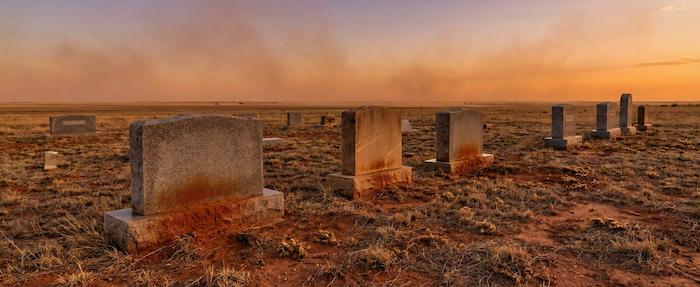
A bronze veteran's plaque in a Tulsa-area cemetery can carry a century of refinery grime from the days the city called itself the Oil Capital of the World; a granite headstone in central Oklahoma's tornado corridor gets storm mud driven straight into its lettering instead, with no refinery history involved. Whatever caused the damage, a Tending headstone cleaning visit to any of Oklahoma's 2,183 cemeteries comes with the same $2,000,000 liability policy and ICCFA membership. Which fix actually helps an Oklahoma headstone depends on what's really behind the damage.
How Oklahoma's Storms and Oil History Shape Headstone Care
Oklahoma's ice storms and shifting clay soil both attack a monument's structure, one from above and one from below. Tornado season drives mud straight into engraved letters most springs, and a century of oil refining around Tulsa and Cushing left bronze markers with their own chemical legacy.
Oklahoma Ice Storms and Headstone Repair
Oklahoma sits in one of the most ice-storm-prone corridors in the country, where freezing rain coats every exposed surface in a solid glaze several times most winters. Rain seeps into a hairline crack before the temperature drops, and once it's trapped inside, the same freeze that glazes the outside of the stone also freezes the water inside it, expanding hard enough to widen the crack. A crack that starts hairline-thin in one ice storm can run the full width of a headstone by the time several more have passed. December 2007's ice storm alone knocked out power across most of the state for over a week, a scale that gives a sense of how much ice can accumulate in a single event. Oklahoma's clay soil adds pressure from underneath at the same time: the clay swells hard when wet spring weather soaks it and shrinks away from a monument's footing once summer heat dries it back out. The shrink-swell cycle repeats every year, and a concrete footing poured without accounting for it eventually cracks or lets the whole base tip. Tending seals a fractured stone with an epoxy made to hold through repeated freeze cycles, and resets a shifting base by excavating the unstable clay and packing the hole with angular gravel that stays stable through every wet and dry season.
Tornado Alley Storm Mud and Headstone Lettering Repair
Oklahoma sits at the heart of what meteorologists call Tornado Alley, and severe spring storms bring straight-line winds strong enough to drive mud, grass, and debris directly into anything standing in their path. A single bad storm can pack a headstone's engraved letters full of mud in minutes, forcing material deep into every groove on the stone. Direct Oklahoma sun bakes the packed mud hard within days, and a name that was legible before the storm can disappear behind a rock-hard crust by the following week. Central Oklahoma's stretch of I-35, sometimes called the heart of Tornado Alley, sees violent spring storms pass through nearly every year. Digging the hardened mud out with a screwdriver or other metal tool scratches the surrounding polish just as easily as it scratches the mud itself. Keeping the crust wet gradually softens it back into workable mud, and a low-pressure rinse afterward clears it out of the letter without any scraping. Headstone lettering repair repaints whatever letter the storm mud had obscured once the groove is fully clean.
Tulsa Oil Refining History and Bronze Marker Restoration
Tulsa and the nearby Cushing oil fields anchored what the world once called the Oil Capital, with dozens of refineries running through the city and the surrounding region for most of the twentieth century. Decades of refinery exhaust settled over the region's older cemeteries, and bronze veterans' plaques in that corridor absorbed sulfur and hydrocarbon residue right along with the granite around them. The residue bonds into a dark, uneven film over a plaque's original patina, and the film only gets thicker as each new decade of exposure builds on the last. Tulsa's Cushing oil fields alone once supported more than fifty separate refineries, and pipeline and storage infrastructure from that era still surrounds the area today. A plaque with a century of refinery-era buildup can lose all its original contrast, leaving a veteran's name and rank unreadable under a uniform dark coating. An industrial-strength degreaser breaks the residue down chemically, and the crew regrinds the raised lettering back to bright bronze before repainting the recessed background. Bronze marker restoration finishes with a fresh clear coat, giving a plaque with a century of history behind it a clean surface that starts the clock over again.