
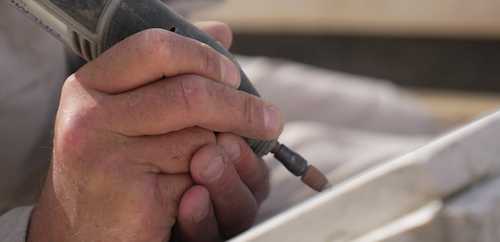
Painted lettering in Oklahoma fails for a handful of very different reasons depending on what's actually hitting the stone. Intense summer sun boils the binder right out of factory paint until it flakes off in the wind. Wind-driven grit sandblasts letters clean off an exposed face over time. Red clay mud dries into the letter grooves and traps whatever paint is left underneath it. And a bad ice storm can shear paint loose across an entire face at once, not just inside a single groove. Our guide to restoring faded headstone lettering walks through what each of those looks like up close. Tending's lettering work across Oklahoma carries a $2,000,000 liability policy and the ICCFA's membership standards.
UV Heat and Boiled Paint
A dark granite face in direct Oklahoma summer sun can reach temperatures that outright boil the resin binder in ordinary monument paint. Once that binder turns brittle, the pigment on top of it has nothing left to hold onto, and it flakes away in sheets that the constant plains wind carries off within days.
Tending's crew strips whatever paint is left down to bare stone, since a partial repaint over boiled residue never bonds evenly, and repaints once the carving is clean.
Wind-Driven Grit Erosion
The same wind that stresses monument joints also carries a steady load of fine grit across open cemeteries, and that grit works like sandpaper against anything raised or recessed on a headstone's face. Given enough years, it can grind painted lettering down to bare granite even where the paint itself never actually failed.
The crew clears any remaining paint fragments from the eroded groove and repaints once the surface is even and clean, since painting over an unevenly worn groove leaves a patchy result. Stones facing directly into the prevailing wind out of the southwest tend to show this wear years ahead of a marker set just a row or two behind them.
Red Clay Packed in the Grooves
Wind carries wet red clay into open letter grooves during a storm, and Oklahoma's summer heat bakes that mud into something closer to a soft brick than ordinary dirt. Left in place, that packed clay holds moisture directly against whatever paint survives underneath it and speeds up a failure that heat alone would have caused eventually anyway.
Tending's crew picks the baked clay out of the groove by hand, since a pressure washer would only drive water and grit deeper into the stone, and dries the groove fully before repainting.
Ice Storm Paint Shear
A heavy Oklahoma ice storm can coat an entire headstone face in a solid shell of glaze ice, and when that shell finally breaks apart or slides free, it can pull away any paint that was already starting to lift. Unlike ordinary weathering, the loss tends to happen everywhere on the face at the same moment, not one letter at a time.
Tending's crew documents which letters were affected before starting, strips any remaining loose paint, and repaints the full face so the lettering matches evenly across the stone. A partial touch-up after an event like this almost always leaves a visible seam between the old paint and the new, which is why the crew treats the whole face as a single job and skips patching individual letters one at a time.
Headstone Lettering Repair Costs in Oklahoma
Two numbers drive a lettering quote: how many characters need repainting, and how deep the original carving actually runs. Uploading photos to the pricing page is enough to pull both measurements and return a locked price. Whether the damage came from an ice storm or years of ordinary UV fading doesn't change that number, since the lettering itself is the only thing being priced. Once the repaint wraps up, photos go into the app so the family can look it over without a trip back to the cemetery.
- UV-boiled paint repaint: full strip and repaint to bare granite.
- Grit-eroded lettering repaint: groove clearing and even repaint.
- Clay-packed groove restoration: hand clearing, drying, and repaint.
- Ice-storm shear repair: full-face strip and repaint for even color match.
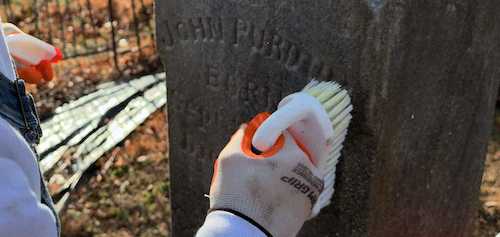
How Our Headstone Lettering Repair Process Works
- Clearing Packed Red Clay Out of the Groove Whatever's packed into the groove, dried red clay, wind-blown grit, or old paint fragments, gets picked out by hand until the carving is back down to bare granite.
- Picking the Boiled Paint Residue Out of the Cuts Any boiled or flaking paint residue still clinging to the groove walls comes out next, since fresh enamel won't bond over what's left of the old coat.
- Drying the Groove Completely in the Heat The groove is left to dry completely in the Oklahoma heat before any new paint goes on, since sealing moisture in under fresh enamel is one of the fastest ways a repaint fails.
- Filling the Dry Cuts With Fresh Lithichrome A UV-stable, commercial-grade lithichrome enamel goes into the dry groove, matched to the original letter depth and font.
- Clearing Excess Enamel and Filing the Photo Proof Excess enamel gets cleaned off the surrounding granite, and finished photos are logged to the app for the family's records.
