
What actually fails on a painted South Carolina headstone changes almost completely by region, more so than for stone or bronze. Around Aiken and the Sandhills, wind carries fine kaolin clay dust, mined commercially in that part of the state for more than a century, straight into open letter grooves. Along the coast, fallen palmetto fronds pile up around low-set markers and hold damp litter against the lettering far longer than open ground would. In the old Lowcountry phosphate districts near Charleston, a legacy of the state's 19th-century mining boom, fine mineral dust still works its way into carved lines. And the subtropical humidity blanketing the entire state promotes black mildew growth on painted surfaces faster than almost anywhere else in the country. Tending's guide to restoring faded headstone lettering goes into each of these in more depth. Lettering work completed anywhere in South Carolina carries a $2,000,000 liability policy, and Tending is a standing member of the ICCFA.
Kaolin Clay Cementation in the Grooves
Commercial kaolin mining has operated around Aiken and the Sandhills for more than a hundred years, and the same fine, powdery clay that made the region's reputation drifts into open letter grooves on ordinary wind. A wet spell turns that dust into something close to raw pottery clay, and the summer sun that follows finishes the job, firing it into a plug hard enough to pop loose whatever paint is left underneath.
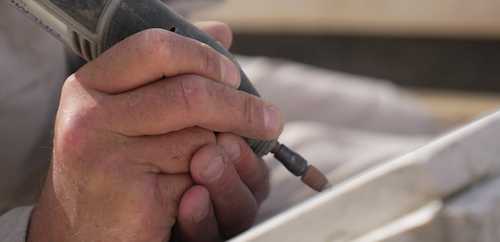
Getting a groove back to bare granite means chiseling that fired clay out piece by piece, since no solvent on the market actually breaks the bond once the clay has cured that hard. The stone gets a full day to dry out afterward before Tending's crew touches it with paint again.
Palmetto Frond Litter and Trapped Moisture
South Carolina's state tree, the cabbage palmetto, sheds heavy fronds on a regular basis, and litter that piles up around a low-set marker holds damp organic material against the lettering far longer than open exposure ever would. That extended dampness works behind the paint and eventually lifts it in small patches, usually starting along the bottom edge of a letter where litter settles first. Markers set flush with the ground near a mature palmetto stand tend to need this cleared more often than a stone standing in open lawn a short distance away.
Clearing out the trapped litter is the first step, followed by whatever staining it left behind in the groove; the crew doesn't reach for paint again until a moisture check on the stone comes back clean.
Historic Phosphate District Dust
South Carolina led the nation in phosphate mining during the 1870s and 1880s, an industry centered on the rivers around Charleston, and fine mineral dust from that era is still present in the soil of a number of older Lowcountry cemeteries. Wind still lifts enough of it into open letter grooves near those former mining districts to pack in and dull whatever paint survives underneath.
Tending's crew clears the packed mineral dust from each groove, dries the stone completely, and repaints once the carving is confirmed clean.
Subtropical Humidity and Black Mildew Growth
South Carolina's heat and humidity together create close to ideal conditions for black mildew on any painted outdoor surface, and headstone lettering is no exception. Left untreated, the mildew darkens whatever color survives and can work its way behind the paint, undermining the bond between pigment and stone.
The crew treats active mildew growth with a dedicated solution before doing anything else, since repainting over it would simply seal the growth in under a fresh coat.
Headstone Lettering Repair Costs in South Carolina
A photo submission gives the pricing page the two numbers it actually needs: character count and how deep the carving runs. Region doesn't enter into the math at all, a kaolin-clogged groove near Aiken and a mildew-stained one on the coast cost the same for equivalent scope. Once the repaint is finished, the crew uploads photos to the app, so there's nothing left for the family to check in person.
- Kaolin-plug removal: hand clearing and full repaint.
- Litter and moisture repair: cleaning, drying, and repaint.
- Phosphate-dust groove clearing: dust removal and full repaint.
- Mildew treatment: biocide application and a fresh repaint.
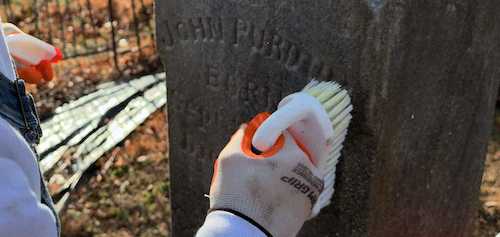
How Our Headstone Lettering Repair Process Works
- Sourcing the Damage to Clay, Litter, or Dust The crew checks whether the lettering's condition traces back to kaolin clay, palmetto litter, phosphate-district dust, or active mildew, since each needs a different fix.
- Prying Baked Clay Free of the Letter Cuts Any hardened clay, packed litter, or mineral dust is worked out of the groove by hand until the carving is fully open again.
- Airing the Cut Out Before Anything Goes Back In Paint waits until the groove has had time to air out completely, because South Carolina's humidity can keep a repaint from bonding if any dampness is still trapped inside.
- Blocking Mildew Before It Gets Sealed Under Paint Any active mildew is treated with a dedicated solution first, since covering it over without treatment would just trap the growth under the new coat.
- Setting the New Color Into the Bare Groove The crew packs a weather-resistant enamel into the dried groove, matching the letter's original font and carving depth, then uploads finished photos to the app for the family to review.
