
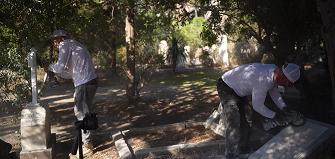
South Carolina's coastline, geology, and even its ground itself create four distinct problems for a cemetery monument, and they rarely have anything to do with one another. Reclaimed marsh ground along the Lowcountry coast holds far less weight than it appears to, and a footing poured into that kind of fill sinks slowly, never failing all at once. Move inland to the Piedmont and Midlands, and the story flips: kaolin-rich clay left behind by weathered granite bedrock swells and shrinks with the seasons, working a footing loose from below. Charleston falls within one of the most seismically active zones east of the Mississippi, a legacy of the 1886 earthquake that still produces occasional minor ground movement today. And live oaks, planted throughout the state's older cemeteries for their shade, send out root systems wide and shallow enough to lift a pad from underneath over the decades. Tending's breakdown of how a headstone restoration actually proceeds covers the mechanics behind repairs like these. Every repair Tending completes in South Carolina is covered by a $2,000,000 liability policy, and Tending holds standing membership in the ICCFA.
Lowcountry Marsh Soil Settlement
Much of the Lowcountry around Charleston and Beaufort was built up on reclaimed marsh ground, soft, low-density fill that famously left some of Charleston's own historic buildings with a visible lean. A monument footing poured into that kind of ground doesn't stay put; it settles unevenly over years as the soft fill continues compacting under the load.
Tending's crew excavates past the soft fill until it reaches soil that can actually bear weight, then pours a footing wide enough to spread the monument's load across more surface area, not concentrated on one soft point.
Piedmont Clay Shrink-Swell
Granite and gneiss bedrock across the Upstate and Midlands weathers, over geologic time, into a deep layer of kaolin-rich residual clay, and that clay swells noticeably when saturated and shrinks back when it dries out. A footing sitting directly on top of that cycle gets nudged a little further out of level every time the ground beneath it expands and contracts.
The crew removes the reactive clay from directly beneath the footing, replaces it with a stable compacted fill that doesn't swell the same way, and repours the base on top of that.
Charleston Seismic Zone Ground Deformation
The 1886 Charleston earthquake remains one of the most powerful ever recorded on the East Coast, and the same seismic zone that produced it, known today as the Middleton Place-Summerville zone, still registers minor activity. Older monuments in the region sometimes carry a slight rotation or lateral offset that traces back to that historic shaking, not ordinary ground settling.
The crew checks whether an offset is old and stable or tied to more recent movement, then resets the monument on a wider footing anchored to resist future lateral shift, not just re-leveled in place.
Live Oak Root Intrusion
Live oaks planted for shade throughout South Carolina's older cemeteries put out root systems that spread wide and stay close to the surface, and a root running under a concrete pad keeps thickening for as long as the tree lives. Eventually the pad has nowhere left to go but up, cracking as one side lifts higher than the other.
The crew cuts back the intruding root growth, clears the fractured pad completely, and pours a new footing on a base fitted with a root barrier to slow the next intrusion.
Headstone Repair Costs in South Carolina
What actually moves the price in South Carolina isn't which of these four causes is responsible, it's how much excavation that cause requires. Digging past marsh fill or resetting a footing after ground deformation takes longer than a straightforward reset in ordinary soil, and that difference shows up directly in the number the pricing tool returns from a few submitted photos. The crew documents the finished repair with photos uploaded to the app before ever leaving the cemetery.
- Marsh-fill footing correction: deep excavation and a wide-span reinforced footing.
- Clay shrink-swell repair: reactive clay removal and a stable-fill repour.
- Seismic offset correction: assessment, re-leveling, and lateral anchoring.
- Root-damage pad replacement: root clearing and a barrier-fitted new pour.
How Our Headstone Repair Process Works
- Sorting Marsh Fill From Seismic Ground Shift Tending checks whether a monument's movement traces back to soft marsh fill, reactive clay, seismic offset, or root intrusion, since the fix differs for each.
- Digging Out to Ground That Actually Holds Weight The crew excavates past whatever's actually unstable, soft fill, reactive clay, or a root-damaged pad, until it reaches ground solid enough to build on.
- Building a Base Sized for the Real Soil A new footing goes in wide enough to spread the load where the ground itself is the problem, or anchored against lateral movement where seismic offset caused the damage.
- Squaring the Marker Up on the New Base The reset monument is checked for level in both directions before the crew calls the repair finished.
- Trimming Roots Back Before They Return Where live oak roots caused the damage, a barrier goes in to slow the next intrusion, and finished photos post to the app for the family's records.
