
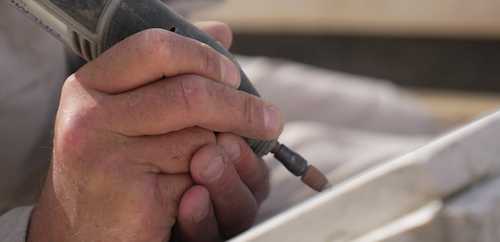
Painted headstone lettering wears down for different reasons depending on where it sits in Wisconsin. The Chippewa Valley deals with fine silica dust settling into carved letters. The rest of the state deals mainly with winter road salt and a hard freeze-thaw cycle instead. Our guide to how lettering repair actually works lays out the process in detail. Tending backs every headstone lettering repair job in Wisconsin with $2,000,000 in liability insurance and its membership in the ICCFA.
Chippewa Valley Frac Sand Grit Intrusion
Western Wisconsin counties around the Chippewa Valley host a large share of the country's frac sand mining. Fine, windblown silica from those operations drifts into carved letter grooves nearby. Unlike cement, that quartz sand has no chemistry that lets it actually bond to the stone. It just sits there, packed in tight, holding dampness against the paint underneath. A groove clogged with damp grit lifts a fresh coat of paint off from below instead of letting it bond properly. Cemeteries well removed from any active mine or rail line rarely build up grit this heavy. Tending digs the packed grit out completely before any new paint goes on.
Winter Road-Salt Crystallization
Wisconsin uses a heavy volume of road salt every winter. Airborne brine from nearby roads settles into exposed letter grooves on headstones close to a plowed route. Dissolved salt wicks into the paint as it gets wet, then recrystallizes as the groove dries out again. That repeated wet-dry cycle physically forces the paint to flake and crumble from the inside. The same basic process is behind salt-spalled masonry elsewhere in the state. Grooves within view of a heavily salted road show this consistently more than plots set further back. Tending clears the salt residue completely before repainting.
Sugar Maple Sap Residue Staining
Sugar maples are common throughout Wisconsin's older cemetery grounds, and dripping sap collects readily inside a carved letter groove beneath the canopy. The sticky residue itself doesn't damage the paint chemically, but it attracts dirt and supports a sooty, dark mold growth wherever it sits. That growth spreads gradually and darkens the surrounding paint unevenly rather than all at once. Plots directly under a mature maple see this considerably more than open, unshaded sections. The residue rarely causes any permanent harm on its own, but it's unsightly enough that most families want it cleared before a repaint. Tending clears the sap residue and any mold growth before repainting.
Wisconsin Freeze-Thaw Paint Failure
Wisconsin winters run cold enough, statewide, to put real stress on painted lettering year after year. Water sitting in a groove turns to ice each time the temperature drops. Ice takes up more room than liquid water does, so something has to give: the paint bond to the stone underneath. No single cold snap does much damage on its own. It's the sheer repetition, one freeze after another across an entire winter, that eventually shows up as flaking. A repaint that skipped a full strip of the old layer tends to give out sooner than one that started from bare stone. Tending clears any loosened paint and confirms the groove is fully dry before repainting.
Headstone Lettering Repair Costs in Wisconsin
The two things that matter most for pricing headstone lettering repair in Wisconsin are how many characters are involved and how deep they're carved. A handful of submitted photos is enough to turn those details into a figure. Running them through the pricing tool means nobody has to set foot in the cemetery. Whether a groove just needs a light cleaning or the full grit-and-residue treatment, the scope is what decides the number. A repaint near Eau Claire and one near Green Bay come out to the same price once that scope matches. The crew posts finished photos to the Tending app once the job is done, so the family can check the result.
- Grit intrusion treatment: packed silica cleared and the groove repainted.
- Salt damage treatment: crystallized residue cleared before repainting.
- Stain removal treatment: sap residue and mold cleared before repainting.
- Freeze-thaw repaint: loosened paint cleared, groove dried, and repainted.
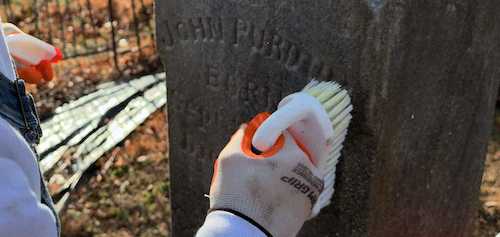
How Our Headstone Lettering Repair Process Works
- Diagnosing the Groove Damage The technician works out whether silica grit, salt crystallization, sap residue, or freeze-thaw cycling is behind the groove's condition, before any work begins.
- Clearing Out Trapped Grit and Residue Sand, salt residue, sap, or old flaking paint, whatever has settled into the groove gets worked out by hand until only bare stone is left.
- Confirming the Stone Is Fully Dry Nothing new goes in until the groove tests fully dry, since moisture trapped under fresh paint is one of the most common causes of early failure.
- Depositing the New Enamel The dry groove receives weather-rated enamel packed in to match the depth and shape of the original carving.
- Buffing the Stone and Uploading Photos Stray paint gets cleaned off the surrounding stone, and the crew uploads finished photos to the Tending app for the family's records.
