
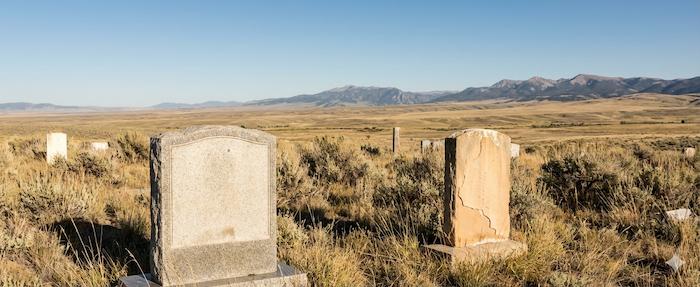
A granite headstone on a Wyoming ranch cemetery can crack or chip after cattle use it as a rubbing post for a season; a bronze veteran's plaque near the Powder River Basin coalfields picks up a fine, low-sulfur coal dust instead, with no livestock involved. Wyoming has just 210 cemeteries, one of the smallest counts in the country, and every one of them gets the same Tending headstone cleaning treatment, backed by a $2,000,000 liability policy and ICCFA membership. Which fix actually helps a Wyoming headstone depends on what's really behind the damage.
How Wyoming's Ranch Country and Coal Basin Shape Headstone Care
Wyoming's frost heave and range livestock both put physical stress on a monument's structure, one from underground and one from a half-ton animal using the stone as a scratching post. The same livestock oil that chips granite corners also stains and obscures engraved letters, and coal dust from the Powder River Basin, the largest coal-producing region in the country, settles on bronze markers of its own accord.
Wyoming Frost Heave and Headstone Repair
Wyoming's ground freezes several feet deep most winters, and water trapped in the soil above that depth expands hard enough to lift a shallow foundation straight up out of the ground. The stone drops back down once the spring thaw arrives, but rarely lands exactly level, and the tilt gets more pronounced with each winter the cycle repeats. Range cattle and deer add their own pressure on rural cemetery monuments, using an upright stone as a scratching post strong enough to hold their full weight. A half-ton animal rubbing against a corner for even a few minutes can chip granite or crack a weakened base outright. Cemeteries near open range or unfenced grazing land see this most often, since livestock wander freely between pastures and cemetery grounds with nothing to redirect them. Tending checks every monument for fresh chips alongside the usual frost damage at each visit, since the two threats often show up on the same stone within a single season. Headstone repair resets a frost-heaved base on a deep gravel bed that drains water before it can freeze again, and reinforces any chipped or cracked corner so the next animal that leans on it has nothing to budge.
Wyoming Range Livestock Oil and Headstone Lettering Repair
Cattle and deer using a headstone as a scratching post leave more than chipped corners behind, since an animal's coat carries a heavy natural oil that transfers onto the stone with every rub. That oil soaks directly into granite's pores, and it settles into engraved letters along with the rest of the surface the animal contacts. A name coated in absorbed animal oil darkens and dulls, losing contrast against the surrounding polish until it becomes difficult to read from any distance. Ordinary soap and water barely touch oil that's already worked its way into the stone, since soap alone doesn't break down the specific fats and waxes found in animal coat oil. Markers positioned at a corner or along a fence line tend to see the most repeated contact, since livestock naturally gravitate toward the same fixed points on a regular route. An enzyme wash breaks the oil down chemically, lifting it out of the stone's pores without any abrasive scrubbing. Headstone lettering repair repaints whatever letter the oil had darkened past legibility once the surface underneath is fully clean.
Powder River Basin Coal Dust and Bronze Marker Restoration
Wyoming's Powder River Basin, in the northeastern part of the state, produces roughly 40 percent of all the coal mined in the United States, making it the largest coal-producing region in the country. Nearly all of that coal comes out through surface mining, with massive excavators stripping away soil and rock to reach coal seams close to the surface. The coal itself is naturally low in sulfur, and the dust it produces settles onto bronze markers as a fine, dry particulate that builds up on the surface over time. Bronze plaques near active mining and rail corridors pick up a steady coating of this dust, working into the metal's clear coat the same way it settles into granite's polish nearby. Once the clear coat degrades, the dust packs directly against bare bronze, dulling the surface and hiding raised lettering under an even gray coating. The basin's Black Thunder Mine alone ranks among the most productive coal mines in the country, and rail lines hauling coal out of the region run past rural cemeteries throughout the northeastern part of the state. The crew strips the degraded coating and any packed dust down to clean metal, and bronze marker restoration reseals the surface with a fresh clear coat rated to resist ongoing coal dust exposure.