
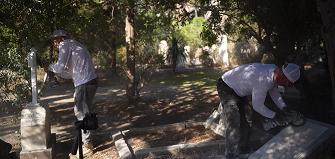
Wyoming cemetery footings fail for reasons tied closely to elevation and soil type. The Bighorn Basin's clay-rich mudstone behaves nothing like the sandy soil found in a mountain-valley cemetery downhill from a heavy snowpack. Our breakdown of the headstone restoration process walks through each stage a repair goes through, start to finish. $2,000,000 in liability insurance and an ICCFA membership stand behind every headstone repair job Tending completes here, and Tending is a proud member of the ICCFA.
Bighorn Basin Mudstone Heave
Big Horn, Park, and Washakie county cemeteries often sit on clay-rich mudstone left over from ancient lakebeds and floodplains. Ranchers and county road crews across the basin deal with the same swelling clay under fence posts and driveways. That clay swells noticeably once spring snowmelt soaks into it, and the swelling pushes unevenly against whatever footing sits above. A monument caught in that kind of movement usually develops a patchy, uneven lean rather than a clean, uniform tilt. The same clay shrinks back down once it dries out later in the season, so the cycle repeats most years. Tending excavates past the swelling layer and anchors the new footing on more stable ground below it.
Snowpack Meltwater Washouts
Wyoming's mountain ranges hold a heavy winter snowpack, and the spring thaw sends a lot of water downhill fast. A cemetery on sloped ground can end up in the path of that runoff. Fast-moving water is genuinely good at carrying soil away from wherever it flows. The same basic erosion pattern shows up anywhere a hillside drains toward a low spot, cemetery or not. A footing that loses the soil supporting it on one side settles unevenly toward the washout. This shows up most in cemeteries below a steep grade or near a seasonal drainage channel. Tending rebuilds the washed-out section and redirects runoff away from the new footing.
Yellow-Bellied Marmot Burrow Settling
Yellow-bellied marmots favor rocky edges and open ground, and rural Wyoming cemeteries bordering prairie or talus slopes give them exactly that. Their burrows run several feet down and can extend a fair distance underground once a colony settles in. A single active colony can keep expanding for years if nothing disturbs it. The loosened, hollowed-out soil beneath a nearby footing settles gradually as the burrow network expands, rather than dropping all at once. Cemeteries near open rangeland see this far more than plots in the middle of a mowed, maintained lawn. Tending fills the disturbed ground and rebuilds the footing on soil that hasn't been undermined.
Cottonwood and Elm Root Intrusion
Narrowleaf cottonwood and Siberian elm are common shade trees planted around older Wyoming cemetery sections, and both grow thick, aggressive roots close to the surface. A root running beneath a stacked monument thickens year over year. That growth eventually works like a wedge against the joint holding the blocks together. The same pattern shows up wherever an old shade tree's root system reaches far enough to meet a monument's footing. Given enough time, the pressure separates the base from the die or cracks the mortar outright. Plots within reach of a mature tree's root system see this consistently more than open sections without one nearby. Tending removes the intruding root and rebuilds the joint before resetting the stone.
Headstone Repair Costs in Wyoming
Wyoming headstone repair pricing starts with a set of submitted photos rather than an in-person site visit. The actual scope of the damage decides the number, not which county the cemetery happens to sit in. A mudstone-heaved footing near Worland and a washout repair near Jackson cost the same once the underlying work matches. Photos run through the pricing tool return a figure ahead of scheduling. The crew posts photos of the finished repair to the Tending app once the job wraps up, for the family to review.
- Mudstone heave footing rebuild: footing anchored below the swelling clay layer.
- Washout repair: eroded section rebuilt and runoff redirected.
- Burrow settling repair: disturbed ground filled and the footing rebuilt.
- Root intrusion repair: intruding root removed and the joint repaired.
How Our Headstone Repair Process Works
- Assessing the Ground Movement A technician determines whether mudstone heave, washout erosion, burrow settling, or root intrusion is behind the monument's movement before work starts.
- Removing the Damaged Footing The compromised base is dug out completely, along with whatever swollen clay, washed-out soil, or root material caused the failure.
- Bracing the Monument Aside Rigging sized to the stone's weight lifts it clear, opening up room to rebuild the footing correctly underneath.
- Repairing Cracks and Joint Separation A color-matched compound stabilizes any cracking or block separation, restoring structural strength rather than just the surface look.
- Sealing and Uploading the Finished Work A breathable sealant protects the repair, and photos go up on the Tending app once the monument is reset and level.
