
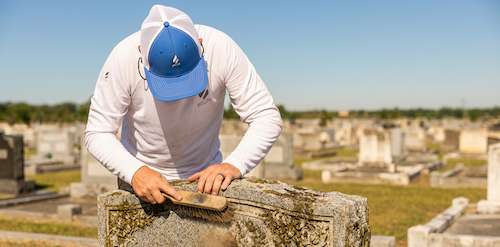
A monument's foundation fails for a different reason depending on which corner of Nevada it sits in: flash-flood runoff in the Las Vegas Valley, freeze-thaw cycling around Reno and Carson City, heavy Sierra snowpack near Tahoe, and wide daily temperature swings out on the eastern high desert. Tending's breakdown of how a full monument restoration actually proceeds covers the stages behind this work in more detail, and every job statewide runs on one fixed-price schedule backed by $2,000,000 in liability coverage and membership in the ICCFA.
Caliche and Flash Flooding in the Las Vegas Valley
Southern Nevada's soil, around Las Vegas, Henderson, and Boulder City, sits on caliche, a hardened calcium-carbonate layer common across the Mojave Desert that barely lets water through. When a monsoon storm drops rain faster than that ground can absorb it, the runoff has nowhere to go but sideways and down, the same mechanism behind the 1999 Las Vegas flood that caused more than $20 million in damage and reached the Strip itself, along with a more recent monsoon event in 2022 that flooded several casino properties in a single afternoon. A footing set into caliche that's since been undercut by that kind of runoff settles unevenly once the water recedes, and the crack pattern that results looks different from a footing that simply cracked from age. Tending's crews check for that undercutting before deciding whether a footing needs a full repour.
Frost Depth Around Reno and Carson City
Reno's record low of minus 16 degrees is part of why Washoe County's building code specifies a 24-inch footing depth, deep enough to sit below the point where the ground actually freezes most winters. Older monuments in the area often went in on a shallower pour, back before that standard was codified, and a footing sitting inside the active freeze zone gets pushed upward a little more with each hard winter. Tending re-pours below the 24-inch line specifically so a repaired monument doesn't drift back out of level after the first cold season following the fix.
Heavy Snowpack Near the Tahoe Border
Douglas and Washoe County cemeteries near Incline Village and the Tahoe basin can see close to 40 inches of precipitation a year, largely as snow, compared with under 5 inches down in the Las Vegas Valley. That accumulated weight presses flat markers down into softened, saturated ground once the spring melt sets in, and a low marker buried under mud after a heavy melt season is a routine call in this part of the state. Resetting one means excavating the marker, compacting a fresh base underneath, and leveling it flush with the surrounding turf again. A monument with a footing that's cracked from the same repeated freeze-thaw cycling common at this elevation sometimes gets flagged for a structural repair on the same visit.
Temperature Swings in the Eastern High Desert
Elko and Ely see daily highs and lows split by 30 to 35 degrees on an ordinary day, among the widest swings recorded anywhere in Nevada, and Elko's all-time low of minus 43 degrees marks just how far that range can stretch through a hard winter. Concrete and stone don't expand and contract at quite the same rate, and grinding through that mismatch every single day for years eventually works an older or shallow-poured footing loose at its base. Where a bronze plaque rides on top of a monument that's shifted this way, the mounting hardware sometimes loosens along with it, a separate issue Tending addresses under bronze marker restoration.
Headstone Repair Costs in Nevada
A family submits photos of the damage through the online calculator, which weighs the type and extent of the problem to return a number on the spot, no walkthrough or in-person estimate required. That process works the same in a Las Vegas municipal cemetery as it does out near Ely. When the crew wraps up the job, photos of the finished repair go up in the app, giving the family a way to see the result themselves without a trip to the cemetery.
How Our Headstone Repair Process Works
- Sizing Up the Job by Photo Nothing gets scheduled until Tending's technicians have looked over a family's photos and formed a working theory of what actually caused the lean or crack.
- Opening Up the Base Once the crew is on site, the base gets excavated so the footing itself is visible, since caliche settling, frost heave, and storm undercutting all leave a different signature underneath.
- Freeing the Monument From the Old Footing Hydraulic lifts take the full weight of the stone off its base, and on the rare job needing complete disassembly, every piece gets numbered before it's set aside.
- Correcting Whatever Actually Failed A cracked stone gets pinned and filled at the structural level; a failed footing gets poured fresh below frost depth. Cosmetic patching without this step just delays the same failure.
- Setting the Stone Back Down The monument is leveled onto the new footing, sealed, and photographed for the Tending app so the family has a record of the finished work.
