A flat marker in a New Mexico cemetery can vanish under a hardened crust of monsoon mud by late summer, caked on by storms that dump half the year's rain in ten weeks; a bronze veteran's plaque nearby degrades from nine dry months of relentless desert sun instead, with no monsoon involved. New Mexico's 843 cemeteries each get an identical Tending headstone cleaning standard, insured by a $2,000,000 liability policy and backed by ICCFA membership. Which fix actually helps a New Mexico headstone depends on what's really behind the damage.
How New Mexico's Monsoon Season and Desert Sun Shape Headstone Care
New Mexico's daily swing from scorching afternoon heat to a cool evening puts constant stress on a monument's granite, sometimes cracking it outright after enough repeated cycles. Monsoon storms each summer cake mud directly over engraved letters, and nine months of dry, relentless sun works on bronze the rest of the year.
New Mexico Thermal Shock and Headstone Repair
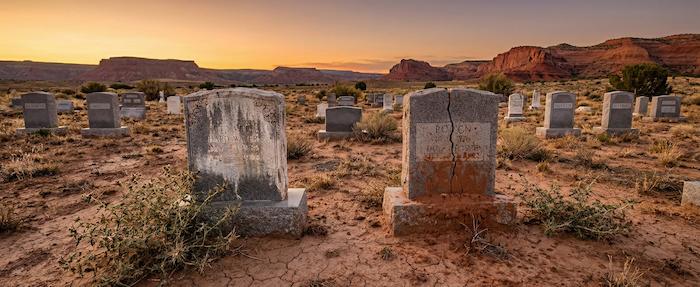
New Mexico's high desert can swing from scorching midday heat to a jacket-cold evening within a few hours, and granite expands and contracts with every one of those daily temperature swings. A single day's swing does no visible harm. The same stress repeated day after day for years eventually opens a hairline crack somewhere in the stone. Once a crack exists, it becomes an entry point for something more destructive than heat alone: winter rain and snowmelt that seeps into the opening and freezes solid overnight. Ice expands hard enough to widen the crack further with every freeze, and a fracture that started as a hairline can pop off an entire corner or edge within a few winters. Markers set in exposed, treeless sections of a cemetery face the widest daily swings, since nothing around them holds the afternoon heat back or slows the evening cooldown. Tending inspects every monument for these early hairline fractures at each visit, since catching a crack before winter matters more than fixing one after the damage is already done. Headstone repair seals a fracture with a stone epoxy made to flex with the day-to-night temperature swing, keeping water from ever reaching the crack in the first place.
New Mexico Monsoon Mud and Headstone Lettering Repair
New Mexico spends most of the year bone dry, and then the North American Monsoon arrives each summer between mid-June and the end of September, dumping as much as half the state's annual rainfall in just a few storm-heavy weeks. The rains typically peak in July and August, right when accumulated dust and grit are at their thickest after a long dry spring. Monsoon rain falls hard and fast onto dust that's had months to accumulate on dry ground, and the impact throws a heavy splash of mud directly up onto any flat or low-set marker nearby. The mud packs into engraved letters exactly the way it packs into every other low spot on the stone's surface. New Mexico's dry air bakes the mud nearly as hard as the granite it's sitting on within days of each storm. A name that was legible all spring can disappear behind a hardened mud mask by the end of monsoon season, especially on markers set low to the ground where splash-back lands hardest. Wiping the crust away while it's still dry only grinds the abrasive dust deeper into the letter. Soaking the crust with plenty of water softens it gradually until it slides off the stone on its own, without any scrubbing needed at all. Headstone lettering repair repaints whatever letter the mud had obscured once the surface underneath is fully clean and dry.
New Mexico Desert Sun and Bronze Marker Restoration
New Mexico stays dry and sun-exposed for roughly nine months of the year, well outside the monsoon window, and that stretch of relentless heat and UV works directly on a bronze plaque's factory clear coat. The coating breaks down chemically under sustained exposure, growing brittle and starting to flake within just a few dry seasons. Once the coating fails, bare bronze underneath faces direct sun with nothing to slow the reaction, and the metal's surface can dull and discolor within a single dry season on its own. Plaques mounted flat, facing straight up into the sun all day, take direct exposure for every hour of daylight. The crew strips the failed coating down to bare metal and reseals it with a finish rated for sustained desert UV. Bronze marker restoration finishes this way roughly every five to seven years in New Mexico, since nine dry months a year wear through even a good clear coat eventually.