
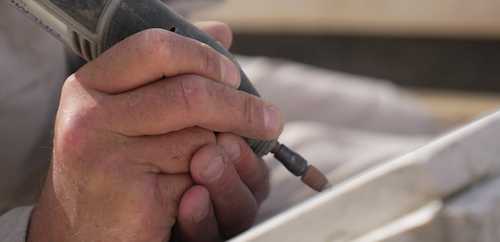
Painted headstone lettering fails for different reasons across New Mexico. Gypsum dust bonds into the groove down in the Tularosa Basin. Intensified UV breaks down paint at altitude around Santa Fe. Fine silt packs into carved letters in the Rio Grande Valley, and wide temperature swings flex the paint loose out on the eastern plains. Tending's guide to fixing faded headstone lettering covers the repainting process in more depth. Every job statewide runs on the same fixed price, and every crew carries $2,000,000 in liability coverage plus membership in the ICCFA.
Gypsum Dust in the Tularosa Basin
Fine gypsum dust blows off the dunes near White Sands and settles into carved lettering on headstones around Alamogordo and Chaparral. Gypsum is calcium sulfate, a mineral soft enough for a fingernail to scratch and soluble enough to dissolve partway in water. Ordinary quartz sand does neither. A summer monsoon shower wets the dust sitting inside a letter groove, and as the water evaporates back out in the desert heat, the dissolved gypsum recrystallizes and hardens into a bonded white crust right inside the channel. That crust doesn't brush away the way loose dust does. It has to be dissolved back out chemically, and painted lettering underneath it is often already stained by the repeated wetting and drying.
High-Altitude UV Around Santa Fe
Santa Fe sits at roughly 7,198 feet, making it the highest state capital in the country, and ultraviolet exposure increases by an estimated 4 to 5 percent for every 1,000 feet of elevation gained. That extra UV attacks the polymer binder holding lithichrome paint together at a molecular level. Ordinary sun exposure elsewhere just fades the pigment gradually. Here, the binder itself breaks apart, and the paint turns brittle and starts flaking away from the stone in small chips within a noticeably shorter span.
Fine Silt in the Rio Grande Valley
The alluvial soil that fills the Rio Grande Valley around Albuquerque and South Valley is a fine silt loam, distinct from the coarser sand common elsewhere in the state. Spring winds lift that fine material easily, and it packs densely into the narrow channel of a carved letter, working its way past a surface that looks clean to a casual glance. Removing it takes narrow picks and a low-pressure rinse. A simple wipe-down just redistributes the silt sitting deeper in the groove, without actually clearing it out.
Thermal Cycling on the Eastern Plains
Clovis, Roswell, and the rest of New Mexico's eastern plains see some of the widest day-to-night temperature swings in the state, commonly 25 to 35 degrees Fahrenheit between the afternoon high and the overnight low under the region's typically clear, dry skies. Stone and enamel paint expand and contract at different rates as the temperature swings through that range every single day. The mismatch flexes the bond between paint and stone at the edge of every carved letter. Over enough cycles, that flexing works small chips loose right along the groove's rim, the same spot where damage tends to start first regardless of what triggers it.
The Repainting Process
Every failed letter gets worked down to bare stone by hand, since new enamel applied over old chips or a bonded mineral crust only conceals the problem temporarily. A solvent matched to the original cause, whether that's gypsum, silt, or UV-brittled paint, flushes the groove, and the channel stays open until it's completely dry before any new material goes in. Enamel gets packed into each letter to match its original carved depth, and a final buff brings back contrast between the paint and the surrounding stone. A loose base or a corroded bronze plaque on the same monument gets scheduled separately, through headstone repair and restoration or bronze marker restoration as applicable.
Headstone Lettering Repair Costs in New Mexico
Tending's calculator prices the job from two figures: how many characters need repainting and how deep the original carving runs, both read from submitted photos. A gypsum-crusted inscription near Alamogordo and a UV-brittled one in Santa Fe are quoted through that identical math, regardless of region or cause. Once finished, the crew posts a photo of the lettering to the app so the family can check the result.
How Our Headstone Lettering Repair Process Works
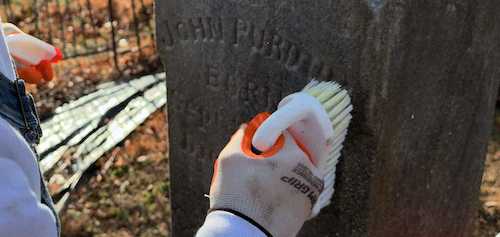
- Clearing Failed Paint From the Groove Every letter gets worked down to bare stone, since packing new enamel over old chips or a bonded crust only hides the problem temporarily.
- Rinsing the Channel With a Matched Solvent Whatever caused the damage in the first place, gypsum, silt, or UV-brittled paint, gets flushed out before anything new goes in.
- Letting the Groove Dry Completely No new enamel goes in until every trace of moisture is gone, since paint packed into a damp channel fails again quickly.
- Packing Enamel to Match the Original Depth Fresh enamel fills each letter to the depth of the original carving, keeping the inscription's proportions consistent.
- Buffing and Posting the Finished Photo A final buff restores contrast between paint and stone, and the finished result gets uploaded to the app for the family to review.
