
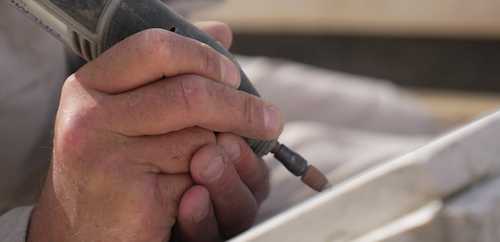
Painted lettering in Tennessee fails through different routes depending on the region. Karst groundwater in Middle Tennessee packs mineral deposits into carved grooves. Flash-flood silt does something similar near the Highland Rim's smaller creeks, just with grit instead of minerals. Near the state's whiskey country and across the humid west, it's biology rather than mineral or grit that does the damage. Our walkthrough of the lettering restoration process goes into more depth on each step. Tending carries $2,000,000 in liability insurance on every job and holds membership in the ICCFA.
Central Basin Mineral-Packed Grooves
Groundwater moving through Middle Tennessee's limestone karst carries a heavy mineral load to the surface. A carved letter groove collects that mineral residue the same way it collects rainwater, and the deposit hardens into a crust behind the paint. Enough buildup eventually pushes the enamel loose from the stone underneath. Older lettering near Murfreesboro and Smyrna tends to show this first, since decades of mineral cycling have had more time to pack the grooves. Tending flushes the packed mineral crust out of each groove before repainting.
Highland Rim Flood Silt in Grooves
Flash floods near the Highland Rim's smaller creeks leave a fine layer of silt over anything nearby once the water recedes. Carved letters collect that silt in the same low spots where floodwater sat longest. Left in the groove, the packed silt holds moisture against the paint and speeds up lifting. A single flood event can do more damage to lettering here than years of ordinary weather would on higher ground nearby. The crew clears the silt out completely and confirms the stone is dry before repainting.
Whiskey Country Fungal Staining
The same Baudoinia fungus that blackens houses and cars near Lincoln County's distilleries settles into carved lettering too. It grows on any exposed surface nearby, not just siding and paint. Painted letters near these barrelhouses can darken and lose contrast faster than lettering elsewhere in the state. The fungus sits on the surface rather than damaging the paint chemically. A heavy film still needs to come off before a repaint will read clearly. Painting over a dark film just traps it under the new enamel instead of removing it. If the crew notices a crack at the base of the monument while they're there, it gets flagged. That part of the fix is quoted separately under headstone repair and restoration. For the lettering itself, Tending strips the film out and repaints once the groove is clean and fully dry.
West Tennessee Groove Dampness
West Tennessee's humidity keeps a carved groove damp longer than it stays damp almost anywhere else in the state. That lingering moisture lets mildew take hold inside the letters before it's visible from a distance. A repaint applied over that dampness often lifts within a year instead of lasting several. Memphis-area cemeteries with heavier tree cover see this even more, since shade slows evaporation further on top of the region's already high humidity. Cemeteries right along the Mississippi see the same slow-drying pattern nearly year-round. Before repainting, Tending's crew works the groove down to bare stone and waits until it's fully dry, no matter how long that takes.
Headstone Lettering Repair Costs in Tennessee
Tending's pricing tool looks at two things in the photos submitted for a lettering job. One is how many characters need repainting; the other is how deep the carving runs. A repaint near Memphis and one near Knoxville land at the same cost when those two factors match. That's true whether the groove just needs a flush or a full mold treatment first. Once the work is finished, photos go up in the Tending app. A family can see the result without making a separate trip out to the cemetery.
- Mineral deposit removal: groove flushed and a full repaint applied.
- Flood silt repaint: full groove clearing and repaint.
- Fungal film treatment: film removed and lettering repainted once dry.
- Mildew treatment: groove cleared, dried fully, and repainted.
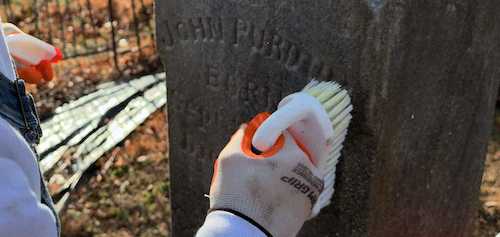
How Our Headstone Lettering Repair Process Works
- Clearing the Old Paint Whatever's sitting in the groove, be it old paint, packed mineral crust, or fungal film, gets worked out by hand until only bare granite is left.
- Residue Wash A targeted solvent pass strips out any leftover film clinging to the groove's walls, since new enamel won't hold onto a surface that's not fully clean.
- Full Dry-Out Nothing goes back into the groove until the stone tests bone dry; leftover moisture under fresh paint is the single biggest cause of an early repaint failure.
- New Enamel Fill The dry groove gets packed with weather-rated enamel that follows the original lettering's exact depth and shape.
- Buffing and Photo Handoff A last pass buffs stray paint off the granite around each letter, and the crew posts finished photos to the Tending app for the family's records.
