
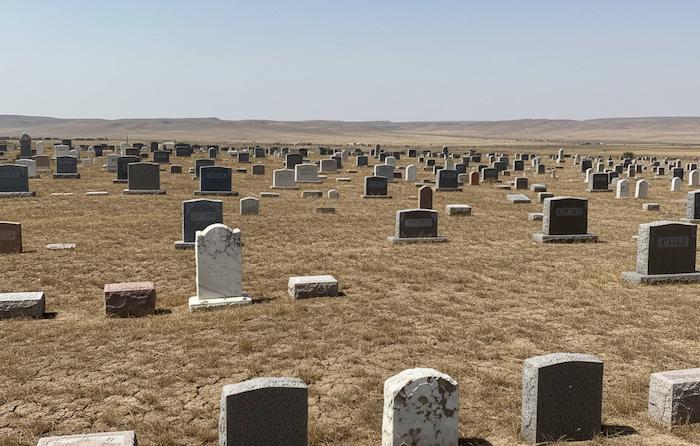
Brazos Bottomland Clay Headstone Sinking
Ground under most Bryan and College Station cemeteries is Brazos bottomland clay, heavy river-deposited soil that turns to thick mud after rain and grips a flat marker's underside and pulls down on it, well beyond ordinary support from below. Once the mud lets go again during a dry spell, the stone has already worked its way down, and a marker level with the grass one year can end up buried under it a few years later. Simply digging a sunken stone back up and setting it on the same clay solves nothing, since the next wet season pulls it under just as easily. A search for headstone cleaning services near me is the natural first step once a marker looks buried like that. The real problem is several inches down, in the clay itself, not on the stone's surface. Once a stone has sunk into that clay, Tending's crew lifts it clear, then anchors a stabilizing grid beneath it before resetting the base. That grid spreads the marker's weight wide enough that the surrounding clay can't work it back under during the next wet season. Tending's headstone repair and restoration service handles that full process in one visit, from lifting the stone to compacting the new base underneath it. That same visit, in Bryan or College Station, falls under Tending's standard $2,000,000 liability policy, and every crew works under our membership in the ICCFA, the industry's leading cemetery and funeral association.
Brazos Valley Algae Headstones
Humidity in the Brazos Valley stays high through most of the year, and cemetery grounds shaded by post oaks rarely get a full day of direct sun to dry out. That trapped moisture supports a dark, soot-colored film of algae and cyanobacteria across granite surfaces, and an untreated stone can go from a faint gray tint to a solid dark stain within a single summer. A pressure washer strips the visible film away but forces spores deeper into the granite's pores, and the growth returns within weeks, heavier than before. Tending's crew treats the surface with a soft-wash biocide, and the discolored patch dries out and brushes free within a couple of weeks, no scrubbing required. Bronze plaques in the same humid cemeteries run into an identical problem, just working through a different material. Standing moisture breaks down a plaque's factory coating from underneath over time, and once that coating gives out, the exposed copper turns a mottled green, the corrosion known as bronze disease. Tending's bronze marker restoration service strips the corrosion down to clean metal and reseals the plaque with a finish built for standing humidity like this.
"Great service and good communication. The maintenance was better than what I expected. They did an awesome job getting rid of all the water marks and giving it a good shine. The only draw back is they did take about 2 months to do the maintenance. Other than that I am very pleased with the end result."
— gustavo galvan, Del Rio, Texas

Post Oak Tannin Headstone Stains
Post oaks stand over most older cemetery sections in Bryan, and cemetery crews here rake leaf drop from post oaks year-round, well past the usual fall cleanup season. Wet leaves left against a headstone's surface break down slowly, and the process releases a dark tannin that bleeds directly into the stone's pores. The result looks like a rust stain or a spilled drink, but ordinary soap and a scrub brush barely touch it, since the discoloration sits inside the granite, not on its surface. Tending's crew works a specialized poultice into the stained area, a paste that draws the tannin back out of the stone over about a day. Once the poultice is rinsed away, the stain lifts out along with it.
Fire Ant Acid Headstone Etching
Fire ant colonies build mounds directly against warm stone bases across Bryan and College Station cemeteries, and the loose dirt in those mounds carries a strong acidic charge from the ants themselves. That acidic soil stays packed against the polish at the base of a headstone and slowly dulls it into a rough, etched ring that won't come off with washing; the polish itself has broken down chemically at that point, a different problem than surface dirt. Tending's crew treats the surrounding ground first to relocate the colony, then applies an alkaline cleaner formulated to neutralize the acid already worked into the stone. That same acidic soil reaches carved lettering at the base of a marker just as easily. Grooves cut into stone trap acidic grit that wind and rain would otherwise clear off a flat surface. Once lettering has etched down this way, plain cleaning won't restore the depth of the original carving. After the acid is neutralized, Tending's crew can recut those letters back to depth through our headstone lettering restoration service, in the same appointment.

Highway 6 Construction Dust Headstones
Construction traffic along Highway 6 and across the Texas A&M campus keeps a layer of fine red dust moving through the air in Bryan and College Station, and it settles onto every flat cemetery surface within days of a new job breaking ground nearby. Overnight moisture bonds that dust into a crusted film across the stone before the morning sun bakes it dry again, and wiping a dry marker down just grinds the grit into the polish, not off it. Tending's crew floods the surface with water first, floating the red grit off before any cloth or brush ever touches the stone, and the polish comes through untouched underneath.
Service Costs in Bryan
Every plan is priced through our online pricing calculator. The marker type and the care level set a fixed cost before anyone visits the cemetery. There is no walkthrough required just to get that number. Our team confirms the scope once they are on site and only adjusts if something was not visible from photos.
- Brazos bottomland clay sinking repair: stone lifted clear, a stabilizing grid anchored beneath it, and the base reset in one visit.
- Algae treatment and bronze plaque care: a soft-wash biocide clears the granite surface, and a matching visit strips corrosion and reseals nearby bronze markers.
- Post oak tannin stain removal: a specialized poultice treatment that draws embedded tannin out of the granite.
- Fire ant acid etching treatment: ground treatment plus an alkaline neutralizer for the stone, and lettering recut back to depth once the acid is cleared.
- Construction dust removal: a water-flood technique that floats grit off the surface without scratching the polish.