
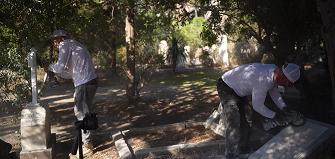
Some Texas headstone movement happens overnight, like a sinkhole opening beneath a plot. Most of it is slower — soil that shifts a little every year until a monument is noticeably out of line. Tending handles headstone repair and restoration statewide, using the same process no matter which kind of movement caused it. The goal of headstone restoration here is always a monument that stays level for years, not one patched to look fixed for a single season. Crews coordinate with cemetery staff directly, and every visit falls under a $2,000,000 liability policy and ICCFA membership.
Gulf Coast Ground Subsidence and Foundation Damage
Tending's Gulf Coast crews recheck monument levels more often than crews anywhere else in the state. Houston-area ground has been sinking for more than a century. Oil and gas extraction drove most of the early sinking, and groundwater pumping from expanding suburbs has kept it going since. Some fast-growing areas west of the city sink close to an inch a year, enough to throw off a monument's footing within a few seasons. Cemetery plots on softer coastal soil see this before plots on firmer ground nearby. A hairline crack or a slight lean here is often the ground moving, not the stone failing.
Hill Country Karst Voids and Sudden Settling
A monument that suddenly drops an inch or two overnight is the most alarming call Tending gets from Hill Country families. Limestone under much of Central Texas dissolves slowly from groundwater passing through it, and that process eventually hollows out small voids underground. Most of the time nothing happens for decades. Occasionally the ground above one of those voids gives way all at once. Clay or fill soil elsewhere in the state usually settles more gradually. Austin and San Antonio cemeteries built on karst terrain see this more than flatter, non-limestone areas nearby. There's usually no visible warning before a void collapses. That's why routine ground checks matter more here than in areas without karst. Tending stabilizes the void beneath the foundation before resetting the stone on top of it.
North Texas Clay Soil and Foundation Cracking
Black clay soil across the Dallas-Fort Worth area can swell or shrink several inches between a wet spring and a dry summer. A monument set into that soil rises and falls with it every year. Uneven movement across a single plot eventually cracks the base or tips the stone off level. Older sections of a cemetery, where the ground has cycled through more wet-dry years, tend to need this kind of correction most often. Tending resets these monuments on a foundation designed to handle that seasonal movement, addressing the ground underneath as much as the stone itself.
West Texas Drought and Foundation Erosion
Wind alone rarely damages a shallow foundation in West Texas. Drought paired with wind erosion is a different problem entirely. Years of dry conditions shrink the soil beneath a monument's base, and wind strips away the loose topsoil that used to help support it. Once enough soil is gone, a foundation that held for decades can start shifting within a single bad drought year. Lubbock and Amarillo area cemeteries see this most after multi-year dry stretches. Rebuilding the foundation on compacted fill usually solves it. Simply resetting the stone on the same thinned-out ground rarely holds.
Ground movement in Texas doesn't always stop at the foundation. Faded or cracked lettering from the same shift falls under headstone lettering repair. A corroded bronze plaque on the same monument is handled separately through bronze marker restoration.
Headstone Repair Costs in Texas
Pricing for headstone repair and restoration in Texas is based on the type of damage and the monument's size. The calculation works the same way regardless of which region caused the damage. Enter both details into the online calculator for a fixed number, with no technician visit required first. A void-related sinkhole repair costs more than a simple releveling, and the calculator reflects that automatically. Materials, labor, and equipment are included in every quote, and photo updates arrive through the app once the visit is complete.
How Our Headstone Repair Process Works
- Site & Ground Assessment A technician checks the monument's geometry along with the soil and foundation underneath. Texas ground moves for very different reasons region to region. Even a small shift can point to a much larger problem below the surface.
- Foundation Stabilization Voids, compacted soil, or cracked bases get addressed before the monument itself is touched. Resetting a stone on an unstable foundation just repeats the same problem later.
- Lifting & Resetting Proper lifting equipment brings the monument back to level without forcing it by hand or with makeshift tools.
- Crack & Structural Repair Cracked or chipped stone gets stabilized structurally, well beyond a surface patch. The goal is stopping the crack from spreading, not a temporary cosmetic fix.
- Weatherproofing & Documentation A breathable sealant protects the repaired area from further moisture damage. Photos of the finished work are uploaded to the app the same day.
