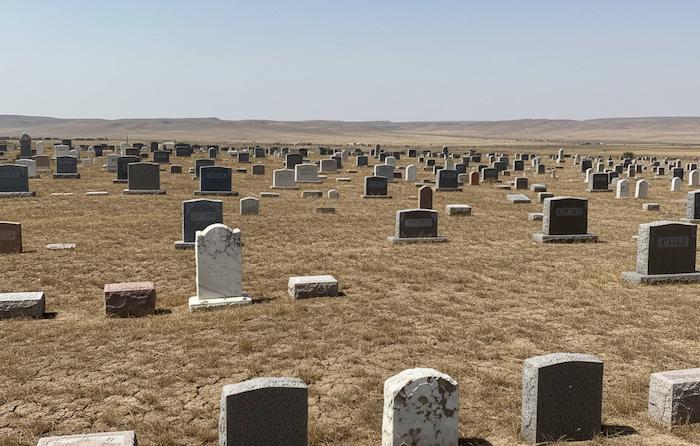
Flash Flood Alley Headstone Saturation
Rain in San Antonio doesn't ease in. It slams down fast and hard, sometimes inches within an hour, onto granite that was baking in full sun minutes earlier. That downpour steams straight into a hot headstone's surface, and the humidity afterward keeps the stone damp for days. Black algae spreads fast in that kind of dampness and grows into the stone itself, taking the shine down from underneath. Anyone searching for headstone cleaning services near me after a marker turns solid black is usually looking at exactly this. A pressure washer looks like the obvious fix, but it drives the spores deeper into the granite and speeds the regrowth. Tending's crew treats it with a soft-wash agricultural biocide built for this growth, with no pressure behind it to push anything deeper. That same humidity works into bronze plaques just as easily, getting past the factory coating and starting corrosion on the metal underneath. The copper turns green and chalky once that happens, a condition known as bronze disease. Tending's crew handles that separately: bronze marker restoration clears the corrosion first, then seals the plaque under a protective finish built for the humidity here. Every job Tending does in San Antonio carries a $2,000,000 liability policy, and our membership in the ICCFA, the industry's leading cemetery and funeral association, backs that guarantee up.
Caliche Soil Monument Shift
Dig a few feet down almost anywhere in Bexar County and you hit caliche, a chalky mix of clay and calcium carbonate. In a drought, it packs down almost as hard as concrete. One heavy storm turns that same ground into loose mud, and a monument's footing loses its grip. The stone leans as the ground underneath keeps shifting. Piling fresh soil against the base doesn't help. The next storm just washes it away along with everything else. Tending's crew digs out the failed caliche around the footing and packs the hole with angular gravel that holds its shape wet or dry. Our crew treats a cracked or leaning monument the same way it treats the soil underneath: excavate the footing, pack in fresh gravel, then reset the stone level again. That combined fix falls under our headstone repair and restoration service, done in the same visit as the soil work.
Edwards Aquifer Headstone Scale
San Antonio's water supply comes straight out of the Edwards Aquifer, and it carries a heavy load of dissolved limestone. A granite monument pulls that water up through its own pore structure, mineral content included. Once the water evaporates off the surface, the calcium stays behind as a chalky white scale across the base. Scraping at it with anything metal takes the polish off right along with the scale. Tending's crew dissolves the buildup with a chelating solution that binds to the calcium, then rinses it away. The polish underneath comes through fine. That same mineral scale collects fastest inside carved letters and dates. Water sits in those engraved grooves after every rain. The flat face around them dries out first, but the scale in the grooves just keeps building. Once a scale layer gets that thick, cleaning alone won't bring the letters back to full depth. Tending's crew doesn't stop at cleaning in that case — headstone lettering restoration recuts the lost detail in the same visit, without a second trip to the cemetery.
"Tending is a platinum standard cemetery/headstone restoration company. I can’t say enough good things about Tending!"
— Beatle, Texas

Bexar County Thermal Shock Headstones
Summer afternoons in Bexar County push past 105 degrees, and black granite gets hot enough to burn a bare hand. When a fast-moving storm finally breaks that heat with cold rain, the stone's surface temperature drops fast while the inside stays hot. That mismatch cracks the stone right at the surface, a hairline at first. Dirt works into the crack, and the same swing each summer keeps widening it. Tending's crew fills a fresh crack with a breathable epoxy that flexes along with the stone's temperature swings. A sealed surface keeps water out of the crack after that.
Live Oak Sap Grave Markers
Old live oaks lean out over a lot of San Antonio's cemeteries, and they drop a steady mix of sap and pollen onto anything underneath. That mix hardens into a sticky yellow film across the top of a marker. Dirt collects in the film, and the whole thing darkens to a dull black over a season or two. Plain soap and water barely touches it. Tending's crew breaks the film down with an alkaline cleaner built for sap and plant residue, and it doesn't touch the granite's finish underneath.
Service Costs in San Antonio
Every plan is priced through our online pricing calculator. The marker type and the care level set a fixed cost before anyone visits the cemetery. There is no walkthrough required just to get that number. Our team confirms the scope once they are on site and only adjusts if something was not visible from photos.
- Flash flood algae removal and bronze care: a soft-wash biocide treatment for stone, with bronze corrosion cleared and resealed under a fresh coating.
- Caliche soil shift repair: full footing excavation and a locked gravel base built to hold through both drought and heavy rain.
- Edwards Aquifer scale removal and lettering restoration: a chelating treatment that lifts calcium buildup, with engraving recut where letters have thinned.
- Thermal shock crack repair: a breathable epoxy fill that flexes with temperature swings, plus a surface seal against water intrusion.
- Live oak sap and residue removal: an alkaline treatment that lifts sap and pollen film while leaving the granite's polish alone.