
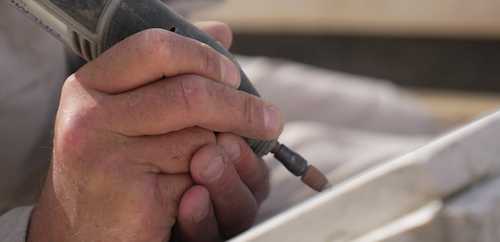
Gulf Coast humidity keeps headstone paint from curing properly for days after it goes on. Six hundred miles west, dry wind and grit wear the same paint away in a completely different way. Tending handles headstone lettering repair statewide using one fixed-price process. Crews coordinate with cemetery staff directly, and every visit falls under a $2,000,000 liability policy and ICCFA membership. See our in-depth guide for the complete five-step restoration process and common DIY mistakes.
Gulf Coast Humidity and Blackened Lettering
Paint on Gulf Coast headstones often looks cloudy or hazy within a year, even before the color itself starts to fade. Constant humidity from Houston to Corpus Christi keeps a thin layer of moisture on the stone most mornings. That moisture works into the paint film before it has fully hardened. Mold and mildew grow inside the narrow carved letters not long after. The bond between paint and granite weakens from underneath, well before anything looks obviously wrong on the surface. Coastal cemeteries in Galveston and Corpus Christi see this pattern more than towns even a short drive inland. A biocide treatment clears the growth first. Tending's coastal crews reletter once the surface has dried out completely.
Restoring Headstone Lettering in the Hill Country
The Edwards Aquifer feeds most of the groundwater around Austin and San Antonio. That water carries more dissolved limestone than water almost anywhere else in the state. Rain and irrigation both pick up that mineral load on the way down to a headstone's base. The residue settles into every engraved letter once the water evaporates. A chalky white film builds up faster in Hill Country cemeteries than in most of the rest of Texas. Wells tend to produce harder deposits than city water systems do. Older lettering with deeply cut grooves collects noticeably more of that scale than shallow, recent carving. Tending's technicians dissolve that mineral buildup with a cleaner suited to limestone-heavy water. Repainting happens letter by letter, once the groove is fully clear.
West Texas Dust and Worn Headstone Paint
Lubbock and El Paso each see wind-driven dust storms a dozen or more times a year. Fine, wind-blown grit works into the paint surface during every one of these events. Repeated exposure wears the enamel down to bare stone faster than sun alone would. Letters near ground level take the worst of it. Blowing sand travels lowest, right where flat markers sit. Panhandle towns see this almost every spring, when wind speeds pick up ahead of the summer heat. Grit gets cleared out of every groove with compressed air before any solvent touches the paint. Tending's crews reletter afterward with enamel made to handle repeated sand exposure.
North Texas Clay Soil and Cracked Paint
Black clay soil across the Dallas-Fort Worth area swells and shrinks with the seasons. That movement flexes flat markers just enough to crack the paint film along old seams. Fort Worth and Dallas both saw a hard freeze severe enough to crack painted lettering in recent winters, though it doesn't happen every year. Trapped moisture in a hairline crack expands and lifts a larger flake all at once. Tending resets and reseals any lettering damaged by that movement. Fresh enamel goes on once the surface is fully dry.
Lettering damage rarely shows up alone in Texas. A monument with cracked paint has often also shifted or sunk into the ground, which is a job for headstone repair and restoration. A bronze veteran's plaque nearby that's gone dark falls under bronze marker restoration instead.
Headstone lettering repair Costs in Texas
Pricing for headstone lettering repair in Texas depends on two things: how many characters need repainting and how deep the original carving runs. Enter both into the online calculator for a fixed number before any work is scheduled. Older, deeply carved lettering usually needs more paint to fill completely than a shallow, recent inscription. There's no technician visit required just to get a quote. Materials and labor are both included in that price. Photos of the finished work go into the app the same day., the same as with any other Tending service in Texas.
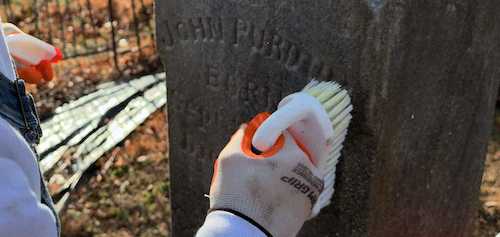
How Our Headstone lettering repair Process Works
- Paint Removal Old, failed paint gets picked and scraped out of each letter down to bare granite. Any nearby bronze fixtures or stonework get masked off first, so tools only touch the lettering.
- Surface Treatment Mineral scale, mold, or embedded grit gets dissolved or cleared depending on the specific damage. Plain sun-fading skips this step and goes straight to repainting.
- Hand Repainting Industrial enamel gets applied by hand into each cleared groove. It bonds directly with the raw granite underneath the surface.
- Finishing & Photo Report Excess paint gets polished off the surrounding stone so only the letters carry color. Photos of the finished work go into the app the same day.
