Franklin Mountains Wind Grave Markers
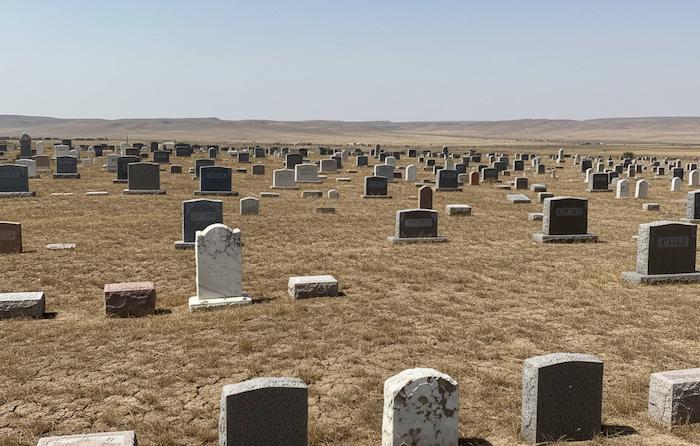
Wind funneling past the Franklin Mountains regularly hits 60 miles an hour in El Paso, and it carries sharp desert grit the whole way down into the valley. That grit strips the polish off a granite marker year after year, and the surface underneath ends up raw and full of tiny open pores. A search for headstone cleaning services near me around El Paso often turns up a pressure-washing service first, and that approach can do real damage to stone this exposed. High pressure forces water straight into those open pores, and the deep cracks that follow don't show up until much later. Tending's crew works a pore-binding consolidant into wind-stripped granite here, then follows it with a sealant that keeps new grit from digging in further. In El Paso, that same $2,000,000 liability policy backs every job Tending does, alongside our membership in the ICCFA, the industry's leading cemetery and funeral association.
Chihuahuan Caliche Monument Heave
Dig into the ground almost anywhere in El Paso and you hit caliche: gravel cemented together by calcium carbonate into something closer to natural concrete than soil. A hard rain turns that caliche into a slurry that can't support any real weight. A week of sun bakes it back into something like concrete, just as unforgiving in the other direction. A monument's footing gets pushed and pulled through both extremes, and it can heave upward or slide sideways depending on which phase catches it off guard. Adding topsoil on top doesn't anchor anything. The next wind just carries it away. Once the caliche around a footing has failed, Tending's crew clears it out completely and rebuilds the base with a friction pile of angular gravel, material that drains fast and won't swell or shrink the way caliche does. A monument that's already heaved or slid from that movement needs the same fix from the ground up. Tending's headstone repair and restoration service resets the stone once the new gravel base is packed and compacted.
El Paso Sun Headstone Exfoliation
Surface temperatures on a dark granite marker here can pass 150 degrees by early afternoon under the Chihuahuan sun. Once night falls, that same stone can drop close to freezing within a few hours. The stone expands hard during the day and contracts just as hard once the cold sets in, and it does this most days of the year in El Paso. Eventually the outer layer of the stone can't keep up with that daily swing, and a thin skin of granite shears away from the surface, a failure called exfoliation. Tending's crew applies a breathable, UV-resistant sealer to stone showing early signs of this. The sealer slows how much heat the surface absorbs each day. That smaller daily swing is what keeps new layers from shearing off.
"Tending is a platinum standard cemetery/headstone restoration company. I can’t say enough good things about Tending!"
— Beatle, Texas
Rio Grande Irrigation Scale Headstones
Rain almost never falls in El Paso, so cemetery irrigation pulls constantly from groundwater near the Rio Grande basin, and that water carries a heavy mineral load. The moment it lands on a sun-baked headstone, most of it flashes off as steam within seconds. The dissolved minerals don't evaporate with it, though, and they bake onto the stone's face as a hard white crust. That crust bonds directly to the granite, and scraping it off takes the polish with it. A chelating rinse is what actually lifts that crust off. It binds to the calcium chemically and carries it away, leaving the granite's polish exactly as it was.
Alkaline Dust Headstone Etching
Wind-blown dust in the El Paso desert runs unusually alkaline, and once morning dew settles onto it, the mixture turns into a mild caustic paste on the stone's surface. That paste slowly breaks down the natural binder holding marble and limestone together. The surface roughens and starts shedding fine grains, the same kind of decay restorers call sugaring. Carved lettering on a marble or limestone marker is usually the first thing to go soft, since dust settles and stays inside the engraved grooves. Once that's underway, Tending's crew can fold headstone lettering restoration into the same visit, recutting the engraving only after neutralizing the caustic residue first. That same caustic dust settles on bronze plaques too, and the dew activating it against stone works the exact same way on a plaque's factory coating. Once the coating breaks down, the copper underneath turns a mottled green, the reaction known as bronze disease. Bronze marker restoration from Tending clears that buildup and finishes the plaque under a coating made to stand up to the same dust that caused the damage. For the stone itself, Tending's crew applies a pH-neutralizing rinse that stops the caustic reaction before it can etch any deeper, then washes the residue away completely.
Service Costs in El Paso
Every plan is priced through our online pricing calculator. The marker type and the care level set a fixed cost before anyone visits the cemetery. There is no walkthrough required just to get that number. Our team confirms the scope once they are on site and only adjusts if something was not visible from photos.

- Wind erosion consolidation: a penetrating consolidant that re-binds sandblasted granite, sealed against further grit exposure.
- Caliche heave repair: excavation of unstable soil and a friction pile of angular gravel, plus monument resetting in one visit.
- Solar exfoliation prevention: a breathable, UV-resistant sealer that reduces the daily heat swing driving surface shearing.
- Irrigation scale removal: a targeted descaling treatment that lifts hard-water mineral crust without scratching the polish.
- Alkaline dust etching treatment with lettering and bronze care: a pH-neutralizing rinse for the stone, engraving recut where needed, plus corrosion stripping and resealing for bronze plaques.