
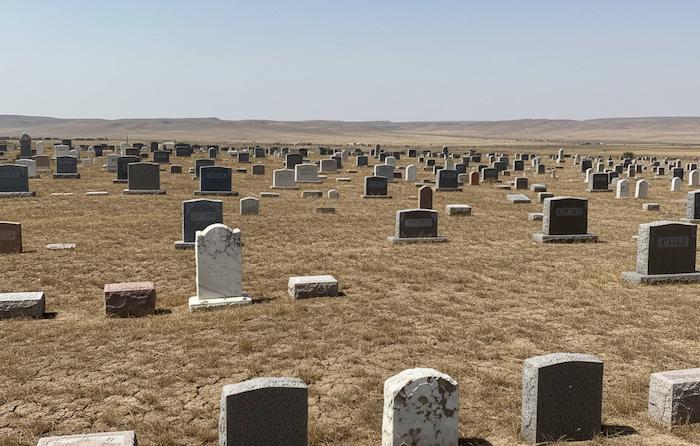
Beaumont Clay Monument Heave
Most cemetery ground across Corpus Christi rests on Beaumont Clay, a coastal formation that swells hard after Gulf rain and pulls back just as hard through a dry summer stretch. That swelling lifts a monument's footing out of level, and the pullback that follows leaves the same footing without support underneath it. A concrete pad poured directly on that clay moves with it every cycle, and old cracks widen along the same lines until the stone above tips. Piling fresh soil under a leaning base changes nothing structurally, since the same clay keeps cycling underneath the new fill either way. A leaning marker here often sends someone typing headstone cleaning services near me into a search bar. The real cause lies below the surface, in the clay itself. Once a footing has shifted from that cycle, Tending's crew excavates past the active clay and rebuilds the base with a compacted layer of crushed limestone, material that drains fast and won't expand the way Beaumont Clay does. Tending's headstone repair and restoration service resets the monument once the new base has cured, and the visit ends with the stone back at grade. Every Corpus Christi job Tending takes on carries the same $2,000,000 liability policy, backed by our membership in the ICCFA, the industry's leading cemetery and funeral association.
Nueces Bay Salt Fog Headstones
Wind off Nueces Bay carries a steady mist of salt spray across cemetery grounds close to the water, and that salt works into a granite marker's surface pores day after day. Those crystals expand with humidity and contract again in dry heat, and repeated cycles pop tiny flakes of polish loose from the surface, a process restorers call salt spalling. A dry brush knocks visible crystals off the top layer but leaves the ones already lodged inside the stone free to keep working. Tending's crew flushes embedded salt out with a low-pressure desalination rinse, then applies a breathable sealer that keeps new salt from settling as deep. That same salt-laden air reaches bronze plaques near the bay just as directly, and chloride in the mist attacks the plaque's factory finish long before ordinary weather would. Once the finish fails, the exposed copper turns a blotchy green, the corrosion known as bronze disease. Tending's bronze marker restoration service pulls that corrosion off the plaque and seals it under a marine-grade coating made to resist the same salt air causing the damage.

Coastal Bend Bio-Film Headstones
Humidity in the Coastal Bend rarely drops much overnight, and cemetery grounds shaded by live oak canopy stay damp most of the day. That constant moisture supports a slick greenish-black film across headstone surfaces, a mix of algae and cyanobacteria that spreads fastest on north-facing stone. A pressure washer strips the film off the top layer but drives spores into the stone's open pores, and the film comes back within weeks, thicker than before. Tending's crew applies a soft-wash biocide formulated to break down algae and cyanobacteria on contact, and the stain lifts free within a couple of weeks with no scraping needed.
"Tending is a platinum standard cemetery/headstone restoration company. I can’t say enough good things about Tending!"
— Beatle, Texas
Corpus Christi Salt Crust Headstones
Wind carries fine salt particles off the bay onto every flat surface in a cemetery, and morning humidity dissolves that salt just enough to let it re-crystallize into a hard white crust once the air dries out again. That crust bonds directly to the granite's surface, and scraping it off with a metal tool takes the polish with it. Tending's crew soaks the crust in a salt-specific descaling solution until the bond breaks down on its own, then rinses the loosened residue away with the polish untouched underneath. Carved letters trap that same salt residue and hold onto it. Wind clears the residue off a flat surface, but grooves cut into stone don't let the wind reach in the same way. Once a name is packed with that much buildup, plain cleaning alone won't bring it back into focus. Tending pairs headstone lettering restoration with the same visit, recutting each letter once the crust is fully cleared.
Bayfront Gull Guano Headstones
Gulls gather over cemetery grounds near the water in dependable numbers, drawn by open ground and food scraps blowing in from nearby lots. Their droppings land on flat headstone surfaces constantly, and the uric acid inside dries into a hard white residue that etches directly into granite polish within days. Left through a full season, that etching can leave a permanent dull patch even after the residue itself washes away. Tending's crew works a neutralizing solution into fresh residue that stops the acid before it reaches the stone's surface, then polishes out any etching that has already set in.
Service Costs in Corpus Christi
Every plan is priced through our online pricing calculator. The marker type and the care level set a fixed cost before anyone visits the cemetery. There is no walkthrough required just to get that number. Our team confirms the scope once they are on site and only adjusts if something was not visible from photos.
- Beaumont Clay heave repair: footing rebuilt on compacted crushed limestone once the unstable clay is cleared out, with monument resetting done the same day.
- Salt fog spalling treatment with bronze care: desalination rinse and breathable sealer for granite, paired with corrosion stripping and a marine-grade reseal for bronze plaques.
- Bio-film removal: a soft-wash biocide treatment that clears algae and cyanobacteria without pressure or scraping.
- Salt crust descaling with lettering restoration: a salt-specific soak that breaks the crust's bond to the granite, followed by engraving recut wherever the buildup had reached it.
- Gull guano etching treatment: a neutralizing solution applied to fresh residue, with polish restored where etching has already set in.