
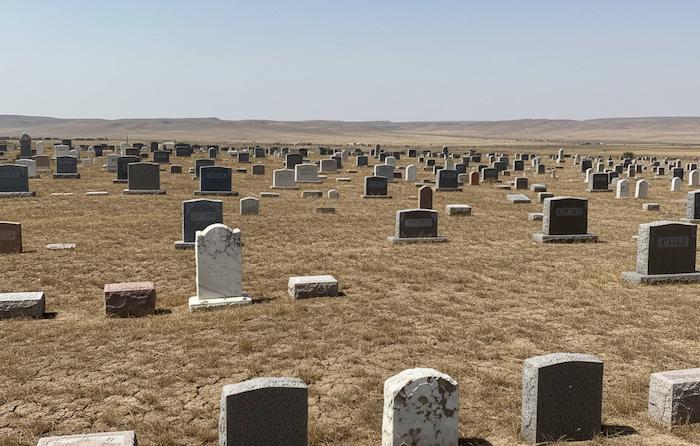
Eagle Ford Shale Monument Heave
Dig down almost anywhere in Arlington and the shovel hits Eagle Ford Shale, a clay-rich formation that moves on its own the way loose soil never does. Rain works into that shale and turns it slick and greasy underfoot. Summer heat pulls the same ground back so hard that cracks open wide enough to reach an arm into. That kind of violent swing shears concrete footers clean through. Depending on the season, a monument here can end up leaning one way or shifted entirely off its original line. Piling extra soil on top does nothing useful here. The next rain just works it into the same moving clay. Tending's crew digs past the active shale layer entirely and packs the space with a bed of interlocking crushed stone that won't respond to rain or heat the way native shale does. The stone above settles onto that base and stays put regardless of which way the shale underneath is moving. A tilted monument here is often what sends someone searching for headstone cleaning services near me, when the shale underneath is really what needs attention. A monument that's already shifted from that movement gets more than just leveling. Once the new base is compacted, headstone repair and restoration from Tending's crew resets the stone and closes out the job in the same visit. Arlington customers get the same coverage on every job: a $2,000,000 liability policy from Tending, plus our standing with the ICCFA, the industry's leading cemetery and funeral association.

Entertainment District Diesel Headstones
Traffic pouring toward the stadiums and along I-30 never really stops in this part of Arlington, and it leaves a steady mix of diesel exhaust and rubber dust in the air. The sun bakes that mix onto a headstone's surface into a greasy black film that clings to the granite's pores. Scrubbing at it while dry just smears the film deeper into the stone. Tending's crew lifts it with an emulsifying paste built for hydrocarbon residue, then rinses the loosened grease away.
Village Creek Fungal Headstones
Shade and humidity collect together around cemeteries near Village Creek, and that combination supports a black fungus growth on stone surfaces there. That fungus, a species of Aspergillus, anchors directly into the stone's mineral structure and releases a mild acid that etches the polish from within. A pressure washer forces the spores deeper into the stone. The growth spreads even faster afterward. Tending's crew treats it with a soft-wash biocide that kills the fungal growth at a cellular level, without any blasting force involved. That same humid shade reaches bronze plaques near the creek just as easily, and over time it breaks down the factory coating from the inside. Once the coating fails, the copper underneath turns a blotchy green, the reaction restorers call bronze disease. Tending's bronze marker restoration service removes the corrosion buildup and refinishes the plaque under a coating made for standing humidity like this near the creek.
Irrigation Calcium Glaze Headstones
Cemetery sprinklers run hard through most of the year here, since natural rainfall alone doesn't keep the grass green in North Texas summers. The local water carries a heavy mineral load. It flashes into steam the moment it lands on a sun-heated headstone, and the dissolved minerals left behind bake into a hard white glaze across the stone's face. That glaze fuses directly to the granite. A metal scraper takes the polish off right along with it. Tending's crew dissolves the bond with a chelating treatment built for this kind of mineral buildup, then rinses the glaze away clean. That same mineral glaze settles thickest inside carved letters. The engraved grooves trap moisture and mineral residue that a flat surface just sheds. Once a name is buried under that much buildup, plain cleaning may not bring it back to full depth. Tending folds headstone lettering restoration into that same appointment, recutting the engraving once the mineral glaze is fully cleared.
"This was my first time using them and they did an absolute amazing job. I highly recommend their services."
— Kelly Tumlinson, Texas
Arlington Granite Blister Headstones
A granite headstone left in full Arlington sun all day heats unevenly: the outer face gets far hotter than the solid core just beneath it. The surface expands with that heat while the core, still catching up, stays rigid underneath it. Eventually the strain between the two separates a thin outer layer from the stone entirely, and it can pop free without warning, a failure known as blistering or exfoliation. Tap a stone in this condition before that happens and it can sound faintly hollow, since the layer underneath has already started to separate even though nothing has fallen off yet. Tending's crew applies a breathable sealer to stone at this stage. It slows how much heat the surface takes on through the day, and that keeps the outer layer from separating further.
Service Costs in Arlington
Every plan is priced through our online pricing calculator. The marker type and the care level set a fixed cost before anyone visits the cemetery. There is no walkthrough required just to get that number. Our team confirms the scope once they are on site and only adjusts if something was not visible from photos.

- Eagle Ford Shale heave repair: excavation past the active clay layer and a bed of interlocking crushed stone, plus monument leveling in one visit.
- Traffic soot and diesel film removal: an emulsifying paste treatment that lifts hydrocarbon residue without scratching the stone.
- Fungal etch removal with bronze care: a soft-wash biocide for the stone plus corrosion removal and resealing for bronze plaques.
- Irrigation calcium glaze removal with lettering restoration: a chelating treatment that dissolves mineral buildup, with engraving recut where the glaze has reached it.
- Granite blister prevention: a breathable sealer that reduces surface heat absorption before a layer separates.