
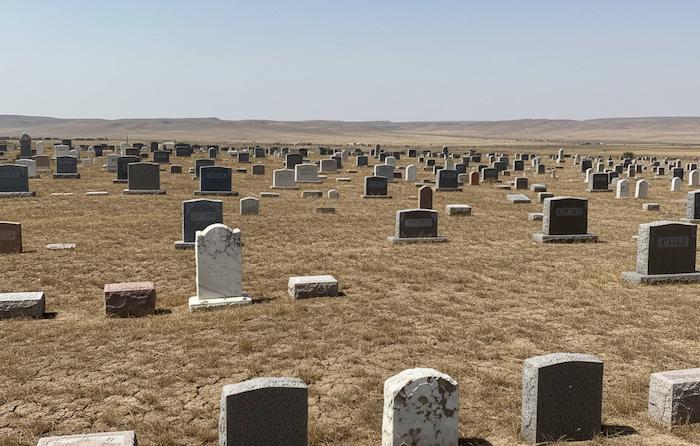
Georgetown Rock Shelf Monument Tilt
Georgetown cemetery ground rarely stays consistent for more than a few feet in any direction: a thin layer of clay sits over solid limestone bedrock, and the depth of that clay layer changes without warning across a single plot. A monument's footing often ends up split between the two, part resting on rock that never moves and part resting on clay that swells after rain and pulls back hard once it dries. That mismatch works against the concrete footer with every wet-dry cycle until it cracks straight through, and the stone above tips hard toward whichever side kept moving. Shoveling soil under the low side changes nothing, since the same clay underneath just keeps cycling no matter what's stacked above it. Most people who spot a tilted monument here start typing headstone cleaning services near me before realizing the problem has nothing to do with dirt on the stone. What's actually failing runs several feet underground, in the shift between rock and clay. Once a footer has cracked from that uneven pressure, Tending's crew drills past the unstable clay and pins the new foundation straight into the solid bedrock underneath, a base the clay layer can no longer push against. Tending's headstone repair and restoration service resets the monument onto that anchored footing in the same visit, and the stone stops moving with the seasons. Every Tending visit to a Georgetown cemetery carries a $2,000,000 liability policy as standard, on top of our membership in the ICCFA, the industry's leading cemetery and funeral association.
"This company just completed the restoration of the markers for my parents. The markers look brand new even though they have been in place for nearly 20 years. I could not have been more pleased with their work. So happy that I found them and the outstanding service they provide."
— Steve Armstrong, Texas
Georgetown Quarry Dust Headstone Cementing
Limestone quarries operate constantly around Georgetown, and fine white rock dust from the crushers drifts across cemetery grounds on almost any dry, windy day. Overnight dew reacts with that dust chemically, and by morning it has set into a thin, chalky film across a headstone's polished face. A few hours of direct sun cures that film harder still, bonding it to the granite the way mortar bonds to brick. Wiping it off dry just grinds the cured particles into the polish, dulling the mirror finish further with every pass. Tending's crew floats the bonded dust free with a high-volume water flush, never a dry cloth, lifting the haze without grinding grit into the stone. That same dust-and-dew reaction reaches bronze plaques nearby, and the mildly alkaline paste it forms works into a plaque's factory coating the same way it works into granite. Once the coating breaks down, the exposed copper discolors into a blotchy green, the reaction known as bronze disease. Through our bronze marker restoration service, Tending's crew strips that corrosion off and finishes the plaque under a coating specifically rated for the same alkaline dust that caused the problem.

Ashe Juniper Pollen Headstones
Ashe juniper, known locally as cedar, blankets much of the Hill Country around Georgetown, and each winter the trees release pollen clouds thick enough to coat a cemetery in a single afternoon. Unlike drier pollen types, cedar pollen carries its own oil, and it melts into a sticky yellow resin the moment it lands on sun-warmed stone. That resin dyes porous marble and limestone markers on contact, and dust collects in it fast enough to turn a pale stone mottled black and yellow within days. Ordinary soap can't cut through the oil at all. Tending's crew breaks the resin down with a surfactant formulated for tree oils, lifting it out of the stone's pores before rinsing the residue away.
Georgetown Well Water Headstone Scale
Cemetery irrigation around Georgetown draws from local well water pulled straight out of the limestone below, and that water leaves behind a calcium load no ordinary rainfall would ever deposit. The sun evaporates the water fast off a warm headstone, but the calcium stays behind and bakes into a thick white scale at the base of the stone. That scale bonds directly to the granite's mineral structure. Any attempt to scrape it off by hand strips the polish underneath along with it. Tending's crew breaks the bond with a buffered acid treatment that dissolves the calcium chemically, then flushes the loosened scale away without touching the surrounding polish. That same calcium scale collects heaviest inside carved letters near the base of a marker, where the engraved grooves trap water long after the surrounding stone has dried. Once a name has scaled over that deeply, plain descaling alone won't bring the depth back. Tending's crew recuts the engraving through our headstone lettering restoration service once the surrounding scale has been fully cleared.
Live Oak Headstone Tannin Stains
Mature live oaks shade many of Georgetown's older cemetery sections, and unlike deciduous trees, they drop leaves steadily through the year and not all at once in fall. A wet leaf pressed against a headstone breaks down slowly and releases tannic acid directly into the stone's pores, leaving a dark brown mark that looks almost like a rust stain. That discoloration sits inside the granite itself, not on its surface, so scrubbing at it does nothing but wear down the polish around the stain. Tending's crew applies a poultice treatment made for this exact stain, and it pulls the acid out of the granite chemically over roughly a day before a final rinse clears it away.
Service Costs in Georgetown
Every plan is priced through our online pricing calculator. The marker type and the care level set a fixed cost before anyone visits the cemetery. There is no walkthrough required just to get that number. Our team confirms the scope once they are on site and only adjusts if something was not visible from photos.
- Rock shelf tilt repair: footing pinned directly into bedrock past the unstable clay, plus monument resetting in one visit.
- Quarry dust cementing removal with bronze care: a high-volume water flush for the stone, paired with corrosion removal and resealing for bronze plaques.
- Cedar pollen resin removal: a surfactant treatment that breaks down tree oil without staining the stone further.
- Well water scale removal with lettering restoration: a buffered acid treatment that dissolves calcium buildup, with engraving recut wherever the scale had reached.
- Live oak tannin removal: a specialized poultice treatment that pulls embedded tannic acid free from the granite.