A granite headstone set into Utah's alkali soil can crumble at the base as salt wicks up through the stone and crystallizes inside it; a bronze veteran's plaque in the Salt Lake Valley corrodes from decades of trapped winter smog instead, with no alkali soil involved. Utah has only 441 cemeteries, one of the smallest counts of any state, and every one of them gets the same Tending headstone cleaning treatment, backed by a $2,000,000 liability policy and ICCFA membership. Which fix actually helps a Utah headstone depends on what's really behind the damage.
How Utah's Desert Soil and Mountain Valleys Shape Headstone Care
Utah's alkali soil wicks salt directly up into a monument's base through capillary action, crystallizing and crumbling the stone from below. Southern Utah's red rock dust packs into engraved letters statewide, and winter temperature inversions trap decades of valley smog against bronze markers along the Wasatch Front.
Utah Alkali Salt and Headstone Repair
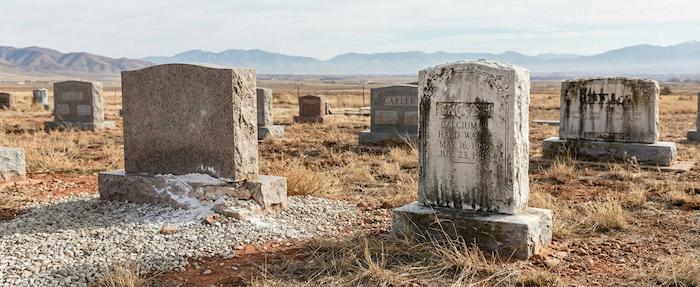
Much of Utah's soil, especially in the basins around the Great Salt Lake, carries a heavy natural load of alkali salts left behind as ancient lake beds evaporated over thousands of years. Granite draws groundwater upward through its own pore structure by simple capillary action, and the water carries dissolved alkali salt along with it. Once the water reaches the surface and evaporates in Utah's dry air, the salt stays behind and crystallizes inside the stone's pores. The pressure of that crystal growth can fracture granite from the inside, and the damage tends to concentrate low on a monument, right where it sits closest to the salt-laden soil underneath. Cemeteries in the basins closest to the Great Salt Lake's historic shoreline sit on some of the saltiest ground in the state, since that soil spent thousands of years soaking in a shrinking lake before it ever dried out. A base left untreated can crumble into loose grit at the corners within a decade in the most affected soil. Digging out the contaminated soil around a monument's base and replacing it with clean gravel breaks the capillary path salt was using to reach the stone. Headstone repair in Utah's alkali soil always starts below ground this way, since surface cleaning alone can't reach damage that starts underneath the base.
Southern Utah Red Rock Dust and Headstone Lettering Repair
Southern Utah's red rock country, from Moab to Zion and Bryce, colors the wind itself with fine iron-oxide dust kicked up off the region's sandstone formations. That dust settles onto every flat surface downwind, and rain mixes it into a thin red clay paste that packs directly into engraved letters. The sun bakes the paste hard within a day or two, staining the stone and filling the groove until a name becomes difficult to read at any distance. Cemeteries closest to exposed sandstone cliffs and slickrock formations pick up the heaviest dust load, since wind erodes fresh grit off bare rock faces with nothing to hold it back. A garden hose alone barely touches hardened red clay once it's cured, since the fine particles bond into the letter almost as tight as the surrounding stone. Keeping the clay wet gradually softens it back into workable mud, and a low-pressure rinse afterward clears it out of the letter without any scraping. Headstone lettering repair repaints whatever letter the red dust had stained once the surface underneath is fully clean.
Salt Lake Valley Inversion and Bronze Marker Restoration
The Salt Lake Valley's bowl shape, ringed by the Wasatch, Oquirrh, and Traverse mountains, traps cold air and pollution against the ground every winter in what meteorologists call a temperature inversion. A layer of warmer air settles on top and acts as a lid, and fine particulate pollution from vehicles and buildings can build up in the trapped air for days or weeks at a stretch before a storm finally clears it out. Bronze veterans' plaques in valley cemeteries absorb that particulate directly during a bad inversion season, and the residue bonds into a dull, gritty film over the metal's original patina. Decades of repeated winter inversions can leave a plaque with a heavy accumulated buildup, hiding the raised lettering and background color under a uniform dark coating. Cemeteries in the lowest parts of the valley floor sit under the thickest layer of trapped air during a bad inversion, since pollution settles into the deepest part of the bowl before it spreads. An industrial-strength degreaser cuts through the film chemically, and the crew regrinds the raised lettering back to bright bronze before repainting the recessed background. Bronze marker restoration finishes with a fresh clear coat, giving a valley plaque a clean surface heading into the next inversion season.