
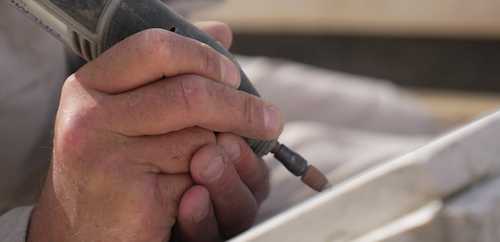
Painted lettering in Utah fails for different reasons depending on the region. Wasatch Front clay holds moisture against carved letters longer than drier ground would. Road de-icer residue works into grooves near well-traveled cemeteries every winter. For the mechanics of the full process, see our guide to headstone lettering restoration. Coverage extends across the whole state, and every job includes $2,000,000 in liability insurance along with Tending's ICCFA membership.
Wasatch Front Clay Moisture in Grooves
The same expansive lakebed clay that shifts footings along the Wasatch Front also holds moisture against anything sitting on the surface above it. A carved letter groove traps that moisture longer than the open stone face around it. Paint applied over a groove that never fully dries lifts within a season or two instead of holding for years. Salt Lake City and Provo cemeteries on lower, flatter ground see this more than sections built up on better-draining fill. Ogden and Layton cemeteries on similarly low ground show the same pattern, just a bit less pronounced. Tending clears each groove down to bare stone and confirms it's fully dry before repainting.
De-Icer Residue in Carved Letters
Magnesium chloride brine sprayed on nearby roads drifts onto cemetery grounds every winter across the Wasatch Front and into the Cache Valley. The residue settles into carved grooves the same way dust does. Because it's hygroscopic, it keeps drawing moisture into the letter even on days that would otherwise be dry. That constant dampness undermines the paint's grip on the stone from underneath. Lettering closest to a cemetery's road-facing edge tends to fail first. Sections set back more than a hundred feet from the road see noticeably less residue buildup year to year. Tending flushes the residue out completely before any new enamel goes in.
Pinyon-Juniper Tannin Staining
Rural cemeteries near Cedar City and Moab often sit close to pinyon-juniper woodland. Juniper debris that collects in a letter groove leaches a mild tannic stain into anything nearby. It's a surface discoloration, not a chemical attack on the paint itself. Even so, it dulls contrast enough that names get harder to read from a distance. Left alone through a few seasons, the staining builds up rather than fading on its own. Sections shaded by mature juniper canopy tend to show heavier staining than open, sunnier rows nearby. Tending clears out the plant debris and lifts the tannin stain before repainting.
Southern Utah Heat-Cycle Paint Fatigue
St. George and the rest of southern Utah swing through some of the widest day-to-night temperature changes in the state. Painted enamel expands and contracts with that swing every single day, not just seasonally. Over enough cycles, the paint's grip on the stone weakens even without any single dramatic weather event. Full sun exposure speeds the process further by adding UV fading on top of the thermal stress. Cedar City sees a milder version of the same swing, thanks to its higher elevation and slightly cooler nights. Tending uses enamel selected to handle repeated expansion and contraction without losing its bond.
Headstone Lettering Repair Costs in Utah
Two details set the price for lettering repair in Utah: how many characters need repainting, and how deep the original carving runs. Both come straight from photos submitted to the pricing tool. A repaint near Salt Lake City costs the same as one near St. George whenever those two factors line up, whether the fix is a simple flush or a full stain-and-residue treatment beforehand. Finished photos are uploaded to the Tending app once the work wraps. A family can then check the result without an extra visit to the cemetery.
- Moisture flush repaint: groove cleared, dried fully, and repainted.
- De-icer residue repaint: groove flushed and a full repaint applied.
- Tannin stain treatment: plant debris and stain removed, groove repainted.
- Heat-cycle repaint: full groove repaint with expansion-rated enamel.
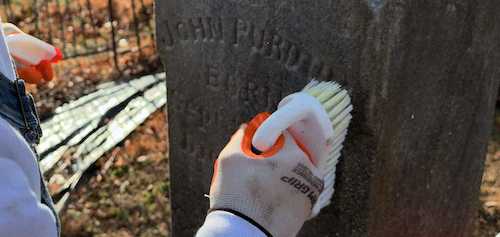
How Our Headstone Lettering Repair Process Works
- Digging Out the Groove Old paint, clay residue, or plant debris, whatever's packed into the carving, gets picked out by hand down to plain granite.
- Solvent Rinse A solvent pass clears out whatever film is still clinging to the groove walls, since fresh enamel won't bond to a surface that isn't completely clean.
- Confirming Bone-Dry Stone The stone has to test fully dry before anything new goes in; moisture sealed under fresh paint is the top cause of an early repaint failing.
- Packing in Fresh Enamel Weather-rated enamel gets pressed into the dry groove, matching the original lettering's depth and shape exactly.
- Final Buff and Upload A final pass clears stray paint off the surrounding granite, and finished photos go up in the Tending app for the family to keep.
