
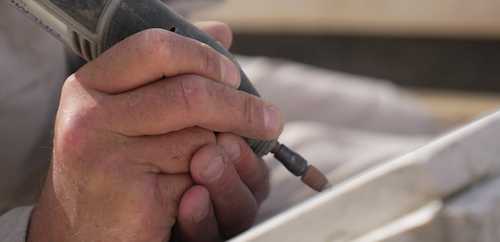
Painted grooves in South Dakota break down through different routes depending on where the stone stands. Black Hills shade keeps a carved letter damp long enough for mold to take hold inside it. Open prairie wind, by contrast, sandblasts paint thin within a handful of seasons. Tending's lettering crews cover the whole state, from Rapid Valley and the Black Hills out to Huron, Brookings, Harrisburg, and Yankton. Our guide to restoring faded headstone lettering covers the process in more depth. Every job is backed by $2,000,000 in liability insurance and membership in the ICCFA.
Black Hills Groove Moisture and Mold
Grooves under the Black Hills forest canopy near Rapid Valley rarely dry out as fast as lettering out on open ground. Mineral-rich spring water seeping through limestone and gypsum karst adds to the dampness. That combination lets a fine mold or lichen film take hold inside the carved letters before anyone notices. The film holds moisture directly against the paint. It's often why a repaint lifts within a year or two, well short of how long it should last. That same dampness also makes a cleared groove slower to dry before the next repaint goes in. Tending's technicians clear the groove down to bare stone and let it dry fully before any new enamel goes in.
Badlands Wind-Scoured Lettering
Fine siltstone dust rides the wind across the Badlands almost constantly. A painted headstone facing open ground takes a slow sandblasting every time conditions kick up. That abrasion thins the enamel unevenly across the letter faces long before the color would normally fade from sun exposure alone. A marker in a sheltered spot just a few plots away can hold its paint for years longer than one standing in open wind. Spot-repainting only the worn letters afterward leaves a blotchy, mismatched finish once the rest of the paint weathers further. The crew clears the thinned paint completely instead.
Missouri River Chalk Dust in Letter Grooves
Chalk-hill bluffs line stretches of the Missouri River valley, and wind lifts fine, pale dust off those bluffs onto whatever's nearby. A carved letter groove collects that dust much the way a windowsill collects household dust. It packs in tight enough to hold moisture against the paint underneath. The packed dust gets flushed out of each groove completely before repainting, since enamel applied over trapped residue won't bond properly to the stone underneath.
Eastern Prairie Sun-Faded Pigment
Open ground across the Prairie Coteau and James River Valley gets more direct sun exposure than a shaded cemetery would. That steady UV load bleaches painted lettering faster than most families expect. A repaint might hold its color for several years in a shaded spot near Sioux Falls or Brookings. Out on unshaded prairie ground, the same repaint can visibly dull within a much shorter span. A handful of older cemetery sections with mature shade trees hold their color noticeably longer than the open rows nearby. Lettering next to a storm-cracked joint gets flagged for a look under headstone repair and restoration during the same visit. Tending uses a commercial enamel formulated to resist UV breakdown.
Headstone Lettering Repair Costs in South Dakota
Pricing in South Dakota comes from two details that the online calculator reads straight from submitted photos. The character count that needs repainting is one factor. How deep the original carving runs is the other. A repaint near Huron costs the same as one near Yankton, since the lettering sets the price, not the location. The finished repaint gets photographed and posted in the Tending app. A family can look it over without a special trip to the cemetery.
- Groove mold and moisture treatment: full clearing, drying, and repaint.
- Wind-abrasion repaint: complete removal of thinned paint and a fresh, even coat.
- Dust removal and repaint: groove flushing paired with a full repaint.
- UV-rated repaint: fade-resistant enamel packed into the original groove depth.
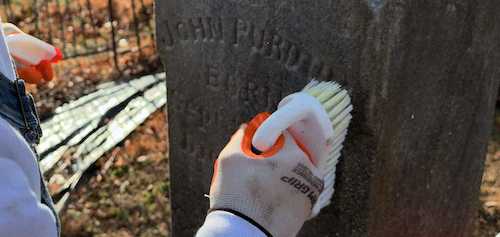
How Our Headstone Lettering Repair Process Works
- Groove Clearing Old paint, packed dust, or mold film gets picked out of the groove by hand until the carving is back down to bare granite.
- Solvent Preparation A solvent wash lifts whatever residue is clinging to the groove walls, since even a thin film keeps new enamel from bonding.
- Drying The stone has to be confirmed bone dry before anything goes on; moisture trapped under fresh enamel is what usually causes a repaint to fail its first hard season.
- Enamel Application Weather-rated enamel gets packed into the dry groove at the depth and shape of the original lettering, not just painted over the surface.
- Polishing and Finishing A final buff clears excess paint off the surrounding granite, and the crew uploads finished photos to the Tending app for the family to keep.
