
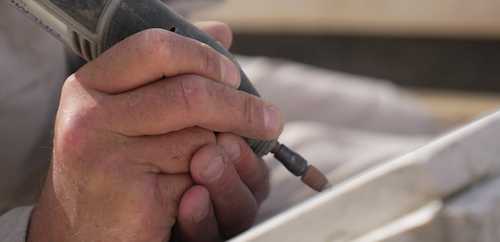
Different parts of West Virginia wear down painted headstone lettering in different ways. Coal country deals with fine dust working into carved letters near processing sites. The Allegheny Highlands deal with a much colder, harder freeze cycle instead. Our guide to how lettering repair actually works lays out the process itself in detail. This service covers headstone lettering repair the length of the state. Every job includes $2,000,000 in liability insurance, and Tending holds membership in the ICCFA.
Coal Dust Grit Intrusion
Cemeteries near coal processing plants and rail corridors in the southern counties deal with fine coal grit settling into carved letter grooves. It happens on a near-constant basis. Once wet, that grit packs down tightly inside the recessed lettering and clings to the surface underneath rather than dissolving or rinsing away. A groove full of compacted grit resists a fresh coat of paint bonding properly, no matter how carefully the repaint gets applied. Cemeteries a mile or more from any active processing site rarely deal with buildup this heavy. Tending clears the packed grit completely before any new paint goes in.
Acid Deposition Paint Embrittlement
Decades of coal-related industrial activity have left parts of West Virginia with a documented history of acidic atmospheric deposition. That acidity does real, measurable damage to painted surfaces over time. Rather than the dramatic reactions sometimes claimed, the actual effect is a slow embrittlement. Repeated acidic exposure breaks down the paint binder's flexibility until it cracks and flakes instead of holding its bond. A groove that's been repainted several times without ever fully clearing old, embrittled layers fails faster with each new coat. Older headstones in longtime coal-producing counties often carry several such layers already. Tending strips every embrittled layer down to bare stone before repainting.
Bird and Fruit Staining
Wild black cherry trees are common across rural West Virginia. So are the birds that feed on their fruit, which shows up just as often in cemeteries with mature trees nearby. Bird droppings are naturally acidic, and where they land inside a carved letter groove, that acidity etches lightly into the stone. Over repeated exposure, the surface stains a dull gray or brown. Fallen, pigmented cherry fruit adds its own dark staining wherever it collects in the same grooves. Plots directly beneath fruiting cherry trees see this considerably more than plots without them nearby. Tending clears both sources of staining and neutralizes the residue before repainting.
Allegheny Highlands Freeze-Thaw Failure
Winters run longer and colder in West Virginia's eastern highlands than they do in the lower valleys to the west. That extra cold works directly against painted lettering. Moisture trapped in a groove expands as it freezes, and that expansion gradually breaks the bond between the paint and the stone beneath it. A single winter rarely causes visible failure, but the damage accumulates year over year until flaking finally shows. High-elevation cemeteries in Randolph, Pocahontas, and Tucker counties go through more freeze-thaw cycles each winter than valley cemeteries at lower elevations. Tending clears any loosened paint and confirms the groove is fully dry before repainting.
Headstone Lettering Repair Costs in West Virginia
A technician can price lettering repair in West Virginia from a handful of submitted photos. Character count and carving depth are the two details that matter most. The pricing tool turns those into a figure before anyone visits the cemetery in person. A repaint near Charleston costs the same as one near Elkins whenever the scope matches. That holds regardless of whether the groove needs a light cleaning or a full grit-and-residue treatment first. Once the work wraps up, finished photos are posted to the Tending app for the family to check.
- Grit intrusion treatment: packed coal dust cleared and the groove repainted.
- Embrittled layer treatment: old paint stripped to bare stone before repainting.
- Stain removal treatment: bird and fruit residue cleared before repainting.
- Freeze-thaw repaint: loosened paint cleared, groove dried, and repainted.
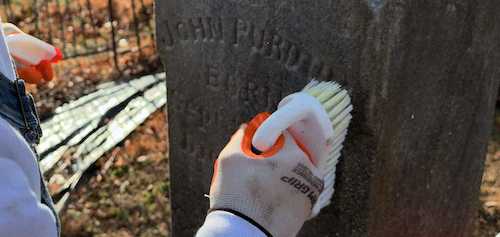
How Our Headstone Lettering Repair Process Works
- Assessing the Carved Groove Whatever's occupying the groove, coal grit, embrittled old paint, staining, or trapped moisture, gets worked out by hand until only bare stone remains.
- Removing Trapped Residue A solvent pass removes lingering residue or staining still clinging to the groove walls, since fresh paint needs a genuinely clean surface underneath it.
- Making Sure the Groove Is Dry The groove has to test completely dry before anything new goes in; trapped moisture under fresh paint is the top reason a repaint fails early.
- Packing In the New Enamel Weather-rated enamel is packed into the dry groove, matched precisely to the depth and shape of the original carving.
- Final Inspection and Photo Upload Any stray paint gets cleared from the surrounding stone, and the crew uploads finished photos to the Tending app for the family's records.
