
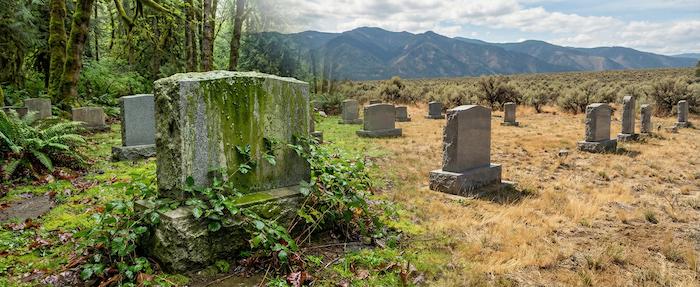
A heavy granite monument in a Puget Sound cemetery can sink into loose glacial till within a decade, with unstable rocky clay underneath giving it nothing solid to rest on; a bronze veteran's plaque in eastern Washington still carries traces of 1980 volcanic ash instead, with no glacial soil involved. Washington has 722 cemeteries spread from the wet Puget Sound lowlands to the dry side of the Cascades, and every Tending headstone cleaning visit among them carries the same $2,000,000 liability policy and ICCFA membership. Which fix actually helps a Washington headstone depends on what's really behind the damage.
How Washington's Glacial Soil and Volcanic History Shape Headstone Care
Glacial till left behind by the last ice age gives Puget Sound cemeteries unstable, rocky soil that shifts under a heavy monument's weight. Tenino sandstone, quarried locally since 1889, erodes at its own pace statewide, and volcanic ash from the 1980 eruption of Mount St. Helens left bronze markers in eastern Washington with a lasting trace of that event.
Puget Sound Glacial Till and Headstone Repair
The last ice age left Puget Sound country blanketed in glacial till, a loose, unsorted mix of clay, sand, and rounded rock scraped up and dumped by advancing and retreating glaciers thousands of years ago. Till drains poorly and holds water through Puget Sound's long, wet winters, and the ground underneath a heavy monument turns to soft mud for weeks at a stretch. A monument sitting on saturated till has nothing solid underneath it, and heavy granite can sink several inches or tip sideways within a single wet season. Sections of a cemetery closest to a low drainage point or old creek bed tend to hold the most water, since till there stays saturated longest into the dry summer months. Adding fresh soil on top of a sinking base rarely helps for long, since the unstable till underneath just absorbs the new fill along with everything else. Tending digs out the failed till and packs the excavation with coarse, angular gravel that lets water drain straight through. Headstone repair on Puget Sound glacial soil holds through the next wet winter on a foundation that stays dry no matter how much rain falls.
Tenino Sandstone Decay and Headstone Lettering Repair
Quarries near Tenino, southeast of Olympia, have supplied Washington with a distinctive buff-colored sandstone since 1889, stone strong enough to survive both the Great Seattle Fire and the 1906 San Francisco earthquake in the buildings that used it. The stone even represented Washington at the Washington Monument in Washington, D.C., and it still faces the state capitol's own dome in Olympia. The sandstone filled headstones across the region too, and Washington's wet, mild climate slowly breaks the stone's grain apart through repeated freeze and thaw. The face of a Tenino sandstone marker flakes away a little at a time, and carved lettering, never cut more than a fraction of an inch deep, loses its edges long before the rest of the stone shows obvious wear. The original Tenino quarries operated until 1938 and sat idle for decades afterward, so any damaged sandstone marker today is working with a stone that hasn't been actively quarried in generations. Stiff brushes and abrasive cleaners strip away weakened surface grain along with whatever grime they were meant to remove, taking a piece of the inscription with it. A gentle water mist clears grime without any mechanical force, and a silicate hardener soaks into the weakened stone afterward to slow further flaking. Headstone lettering repair keeps a worn name as legible as the remaining stone allows, since material already lost to a century of freeze-thaw can't be put back.
Mount St. Helens Ash and Bronze Marker Restoration
The May 1980 eruption of Mount St. Helens sent volcanic ash drifting east across Washington, and communities from Yakima to Spokane saw daylight turn to darkness under a thick gray cloud that took days to fully settle. The ash itself is fine, abrasive volcanic glass and rock particulate, and a heavy layer coated everything left outdoors across the eastern half of the state during and after the eruption. Bronze plaques in cemeteries directly downwind absorbed the ash before anyone had a chance to clear it, and abrasive particles worked into the metal's clear coat, dulling the finish permanently in spots where the ash sat longest. Decades later, some plaques from that era still carry a faint, uneven roughness the eruption left behind. The crew strips any remaining rough patches down to clean metal and polishes out whatever texture the old ash abrasion left in the surface. Bronze marker restoration finishes with a fresh clear coat, giving a plaque that's carried volcanic ash damage since 1980 a smooth, legible surface again.